Book Review #2 Alternate Histories/Dystopian Novels

ZOMBIE

“Dead, yet is alive!

An insatiable hunger

Bites make more undead”

(p. 26)

Image from Zarfling.com

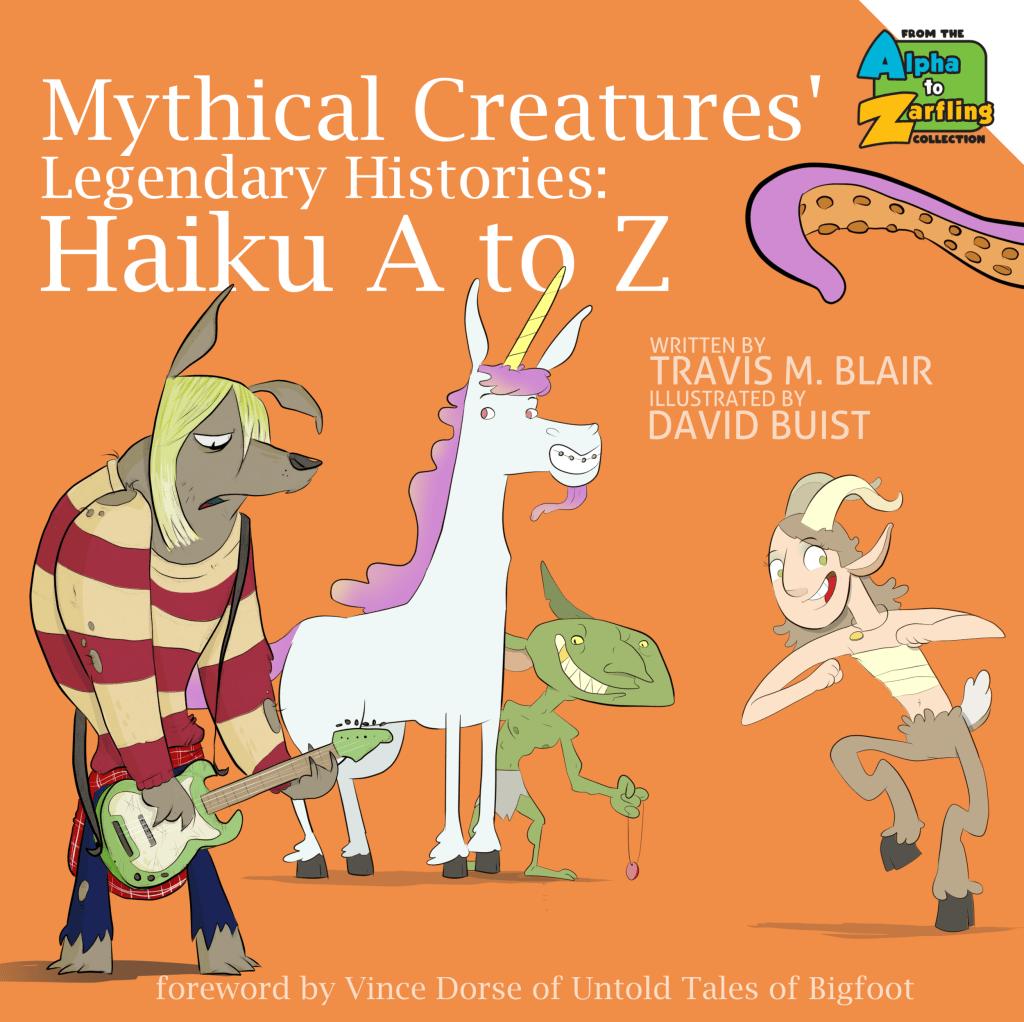
Age 4 – 8: Mythical Creatures’ Legendary Histories: Haiku A to Z written by Travis M. Blair; illustrated by David Buist. Foreword by Vince Dorse of Untold Tales of Bigfoot. From the Alpha to Zarfling Collection. Publisher: Zarfling Platoon. Lexington, KY. 2018. 29 Pages. Cost: $9.50 Softcover (Amazon).  ISBN: 978-1-7326982-1-5

The first time I ever heard the term “liger” was in the movie Napoleon Dynamite. Napoleon was drawing a liger and said “It’s pretty much my favorite animal. It’s like a lion and a tiger mixed… bred for its skills in magic” (Quote.net). It’s one of my favorite lines from the movie. As teachers, we know students can conjure some great combinations of creatures; we also know many students struggle with writing poems. Like mythical creatures, Travis Blair (2018) has twisted these concepts in his children’s book.

Using the haiku method to introduce each creature, Blair treks through the alphabet showcasing 26 different mythical creatures accompanied by a poem. The drawings are not terribly sophisticated, but their simplicity is their appeal: they are colorful and funny – his zombie is dressed like Michael Jackson: “ZOMBIE – Dead, yet is alive! / An insatiable hunger / Bites make more undead” (p.26). The challenge for me was to find something appropriate for readers this age which would fit the alternate history/dystopian category, but I really like what Blair does by blending a high-brow form of poetry (haiku), typically presented with beautifully serene images, and dumps it on its head with is kid-friendly content. Blair provides three great take-aways in his book: the lesson on haikus at the beginning,  the world map provided near the end, so students can see a cultural connection to their favorite mythical creature and perhaps do a little more research (I didn’t know unicorns came from Asia!), and the questions he offers on the last page so students to create their own mythical creatures. Blair bends popular culture in a tongue and cheek fashion by blending popular culture references in his illustrations (could his werewolf be Michael J. Fox from Teen Wolf?) and makes haiku poetry more accessible and less intimidating. Students will enjoy creating their own mythical creatures and then writing haiku poems about them after reading this book.  
Humpty Dumpty sat on a wall

Humpty Dumpty had a great fall

All the King’s horses and all the King’s men

Couldn’t put Humpty together again

Traditional Nursery Rhyme

Image from Amazon.com

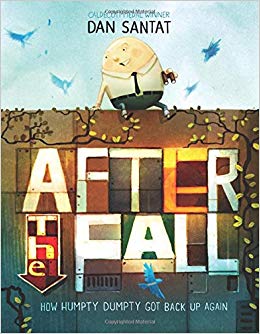
Age 9-11: After the Fall: How Humpty Dumpty Got Back Up Again written and illustrated by Dan Santat. Caldecott Medal Winner. Publisher: Roaring Brook Press, a Division of Holtzbrinck Publishing Holdings Limited Partnership. New York, NY. 2017. 32 Pages. Cost: $17.99 (USA) $24.95 (CAN). ISBN: 978-1-62672-682-6

Most students should be familiar with nursery rhymes by the targeted age group (9-11), but do students know the origin of those nursery rhymes? Or better yet, what happens after the rhyme is over? Do Bo Peep’s sheep actually come home wagging their tails behind them? What about Humpty-Dumpty? He sat on the wall, had a great fall, but no one could put him back together again, or so that’s what we’ve learned. That’s it? Really? Where’s the sequel?  Dan Santat, author and illustrator of After the Fall gives us the “rest of the story” as Paul Harvey might have said to those of us who want to know. After the Fall follows Humpty to the wall to tell us why he was there in the first place and how he fell, to the hospital and the heroic efforts of the king’s men (who do put him back together) “Well, most of me” (p. 4) he tells us, back to the scene of the accident. Yes, it was an accident. Although he is repaired, the scars no one can see are the focus of this book. Using beautiful images in muted tones with close-up perspectives and accessible language for students this age, Santat shows readers how obstacles can stop us from doing what we want as well as the work and courage it takes to get back up again, like Humpty does – no spoiler alert – it’s in the title. The message is clear – we may fall, but we CAN get back up again. This book champions a variety of social-emotional lessons: how to overcome obstacles or conquer negative mindsets, sympathy and empathy discussions, effects of PTSD, or just give students a much-needed self-esteem boost. It would also be a great example of writing alternate endings or creating alternate histories for nursery rhymes.  Why did Little Jack Horner have to sit in a corner? What did his mother say about his utensil choice?  Your thumb, Jack? Seriously?

Some final praise for After the Fall: Santat’s book cover and interior illustrations are superb, but it was the dust cover that reeled me in. The dust cover might appeal to readers on a variety of levels: the industrial look is visually pleasing – a little rugged, a little soft, and a little sheen – the title letters are raised giving the cover a tactile component, and his use of block style, imperfect lettering is something students in this age range could easily mimic. The red down arrow, blue birds and pale blue sky, green vines, and Humpty’s jeans all serve to paint a positive outlook for the story even before a reader opens this book. After the Fall was selected as a Caldecott Medal Winner, and it is easy to see why.  
“If you had some dangerous qualities, your parents could dampen them” (p. 47) …to “keep kids safe and to help them succeed” (p. 48).

Image from Amazon.com

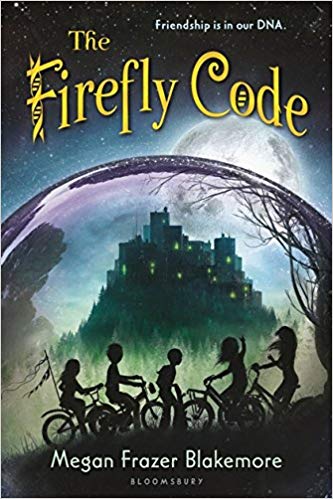
Age 12 – 14: The Firefly Code: Friendship is in our DNA by Megan Frazer Blakemore. Publisher: Bloomsbury. New York, NY. 2016. 338 Pages. $16.99 Hardback (Amazon). ISBN: 978-1-61963-636-1

For just about every young person, turning 13 is a pivotal time because it is the official start to the teen years! Many cultures celebrate this milestone with a party, but what if when you turned 13, you not only get a fabulous party to celebrate your milestone, but you also get to find out your special talent – you know the one that will determine your future – your pathway – your latency? Oh sure, some latencies show up naturally, like drawing well or socializing, and of course, you can be tested, but you won’t get results until you turn thirteen. For the friends in The Firefly Code, Mori, Julia, Theo, and Benji, turning thirteen not only means finding out their special talent, it is also the time to find out who contributed to their DNA. “People can either be natural, which is the old-fashioned way; with genetic material from the mom and the dad. Or they can be designed, which means that their DNA was cloned or modified, either because one of the parents had genetic or fertility problems, or because they just wanted more of a say in how their kids turned out” (p.6). In the first of two books in this series, Megan Frazer Blakemore (2016) writes about what it means to be an outsider, an insider, and a true friend. Everything these emerging young adults believe in will be challenged. Theo declares early in the novel that he wants to pursue puzzles and problem solving, while Mori, the daughter of scientists, wants to do something with visual memory. Their cookie-cutter community, where everyone does essentially the same thing for the same reasons (except for the genetically modified children), is about to be shaken up when new neighbors move in. How will Krita, the major employer in Old Harmonie whose core values are “creativity, ingenuity, experimentation, and order” (p.6) deal with the changes? Can the community and friends handle the non-technology approach to life that Iliana craves? Will the four friends weather the storm of unanswered questions they uncover?

Blakemore incorporates modern technology into this YA novel that will appeal to many young readers – self-driving cars, watches that store health data, meal-delivery service, and genetic modifications on both the positive and negative sides. The medical testing to find out latency is more physically challenging than a standardized test, but the results happen earlier. Similarly, if a child shows some unpleasant behaviors, he/she could be subject to “dampening” which was “the opposite of latency. If you had some dangerous qualities, your parents could dampen them” (p. 47) …to “keep kids safe and to help them succeed” (p. 48). The characters all discuss ways they can solve problems using technology – they are living the four pillars of the Krita corporation. Blakemore also uses numerous nature and conservationist references in this novel. For example, Mori planted three trees in her neighborhood to make it more unique; she loves flowers – Gerber daisies (p.41), specifically; and her family practices composting and recycling with verve. These aspects provide the nature/nurture piece for readers. One downside, and it’s a small one, is the dialogue. The grown-up dialogue from the pre-teen and teen characters was not what I expected to hear, so suspending some belief is necessary. Our narrator, Mori, is only twelve, but she lives in a futuristic, technology driven world, so that could be the reason the dialogue is elevated. The medical details are also quite sophisticated which could throw off some readers.

Overall, this is a great little book for YA readers. It will bring up some great discussions about friendship and how asking the harder questions often brings about some needed answers.
There are three parts to learning: information, knowledge, and wisdom. A mere accumulation of information is not knowledge, and a treasure of knowledge is not, in itself, wisdom. (Caine, p.46)

Image from Amazon.com

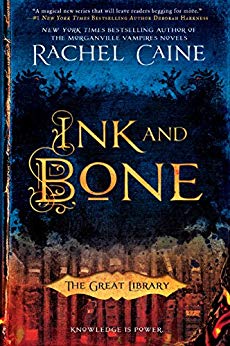
Age 15+   Ink and Bone (The Great Library Book 1) by Rachel Caine. Publisher: Penguin Group. New York, NY. 2016. Digital Edition Published May 2015.  354 Pages. Cost: $1.99 (Kindle Edition) Digital ISBN: 978-0-698-18081-9

“A man cannot be reduced to paper, to lines and letters! He cannot be consigned to a shelf! A life is worth more than a book! Vita hominis libro valet!” (p.34), so writes Rachel Caine (2015) in her novel Ink and Bone (The Great Library Book 1). As Caine’s story unfolds, the characters who revere learning, knowledge, and wisdom learn that books hold a much higher value in this world where The Great Library has supreme power in 2041. While librarians and educators might cheer (as I did, at first), books, in this novel, lead to clashes between nations, altar human dignity, drive people to deceptive behaviors, and, in some cases, murder. All because books are THE priority.

This novel reminded me of the Harry Potter series, where young people take on the weight of their world and solve problems. Caine, however, creates characters who not only love books and want to serve their countries, they also have the desire to change to world. This book follows the journey of Jess Brightwell, who “had grown up a smuggler, understanding that books were a precious commodity, understanding that his family catered to a basic human hunger” (p. 137) to his “forced” quest in service with The Great Library (a noble position). Jess loves to read and has great respect for the written word, but written words get him in trouble.  Tested, then carefully selected, 30 postulates travel to Alexandria, Egypt “the first place in the world to encourage common people to read and learn. The first to educate without regard to status, creed, sex, or religion” (p. 55) for training, but only six will be offered positions with The Great Library. Who will survive? The postulates undergo lessons and tests like those on Survivor or in an escape room – figure out the puzzle and live. Hesitate and pull a tile that determines elimination from the program.

The pace of the novel starts off slowly, but like a roller coaster, takes readers on an up and down journey which keeps readers riveted to the page (or device). Caine creates a world where readers will easily connect to the technology and devices her characters use. A CODEX sounds like our current smartphones, while ‘blanks’ sound much like a Kindle or reading device. Jess prefers real books to a blank because “a blank is a poor, pale imitation, though the words are arranged in precisely the same order; it is the difference between an idea and a physical thing, legal or not” (p.58). Of course, we do not yet have translation chambers that can transport us to a totally different country with some ease, but there is still time. Readers may see hints of Professor Snape of Hogwart’s fame in the character of Scholar Wolfe, shades of our military service academies – think West Point or Air Force Academy – and their gas chamber training; maybe even an homage to Charlie and the Chocolate Factory in the character of Thomas Schreiber, a loveable German engineer.

The novel is chockfull of notable quotes about books, knowledge, and wisdom. Here are some of my favorites:

…the library still held everything he’d ever wanted, too. All the knowledge in the world, at his fingertips (p. 28).  

The Library holds itself to be the keeper of both knowledge and wisdom, but it is not true. So much should never be held in the hands of so few, for it is a natural, venal habit of men to hold to power. And knowledge is the purest form of power (p. 47).

The first purpose of a librarian is to preserve and defend our books. Sometimes that means dying for them – or making someone else die for them. Tota est scientia. Knowledge is all (p.62).

The reading of all good books is like conversation with the finest men of the past centuries (p. 74).

The Library doesn’t need sheep. It needs people who think for themselves. People who can stand up to a challenge (p.122).

Since this is the first book in the five-book series, Caine leaves the door open at the end for the next novel, called Paper and Fire. One last note of praise for Ink and Bones is the eclectic playlist Caine provides at the end of the novel. Especially for those students who need to have music to create their work, Caine enlightens readers to the music she used to inspire her writing which helped me appreciate her work even more.

References

Blair, T.M. (2018). Mythical creatures’ legendary histories: Haiku A to Z.  Lexington, KY: Zarfling Platoon.

Blakemore, M.F. (2016). The firefly code: Friendship is in our DNA. New York, NY: Bloomsbury.

Caine, R. (2016). Ink and bone (The great library book 1). New York, NY: Penguin Group.  

Quote.net (n.d.) Napoleon Dynamite quote. Retrieved from https://www.quotes.net/mquote/66636

Santat, D. (2017). After the fall: How Humpty Dumpty got back up again.  New York, NY: Roaring Brook Press, a Division of Holtzbrinck Publishing Holdings Limited Partnership.
BLOG #3: What if? Alternative Historical Fiction Permutations

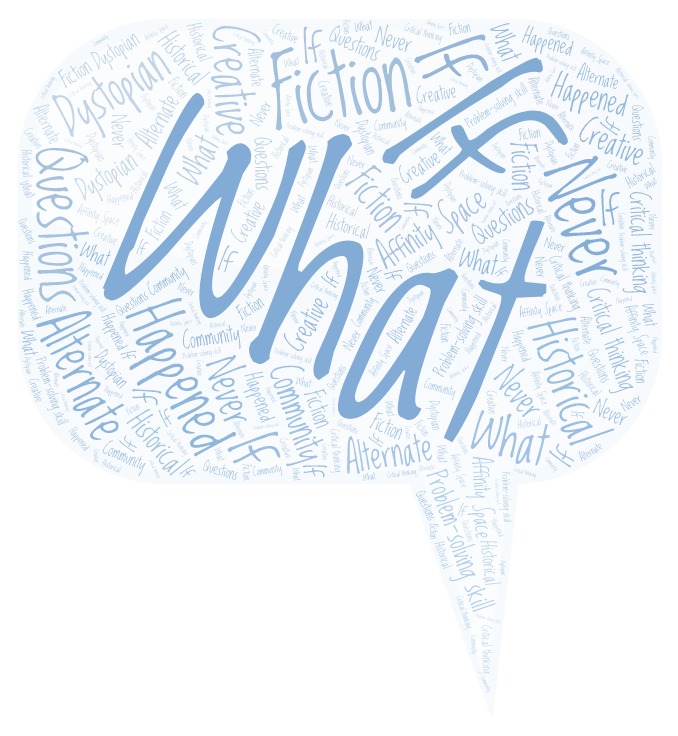
Word Art created by E.Knoop at wordart.com July 2019

“What if…” is the beginning of the most powerful question in the English language.  It offers opportunities and helps people view situations differently.  In literature, the lens of “what if” takes shape under the genre of alternative historical fiction.  For those of us not well-versed in the term alternative historical fiction, consider it this way: what if Tesla won the electricity war instead of Edison? What if Shakespeare didn’t write his plays and poems? What if Lee Harvey Oswald killed Jacqueline Bouvier Kennedy instead? What if Hillary Rodham Clinton became the first female President of the United States? What if SpongeBob was collected for research by a well-intentioned marine biologist? (Not sure that episode hasn’t already been written, but maybe.) What if ALL the Disney theme parks suddenly closed?  What if ants carried machine guns? (Okay, that last question came directly from my seventh-grade Texas history teacher, Mr. Ruttman, who answered my questions (and all of the ones he had no answer for) with that one to get me to “simmer down, young lady.”)

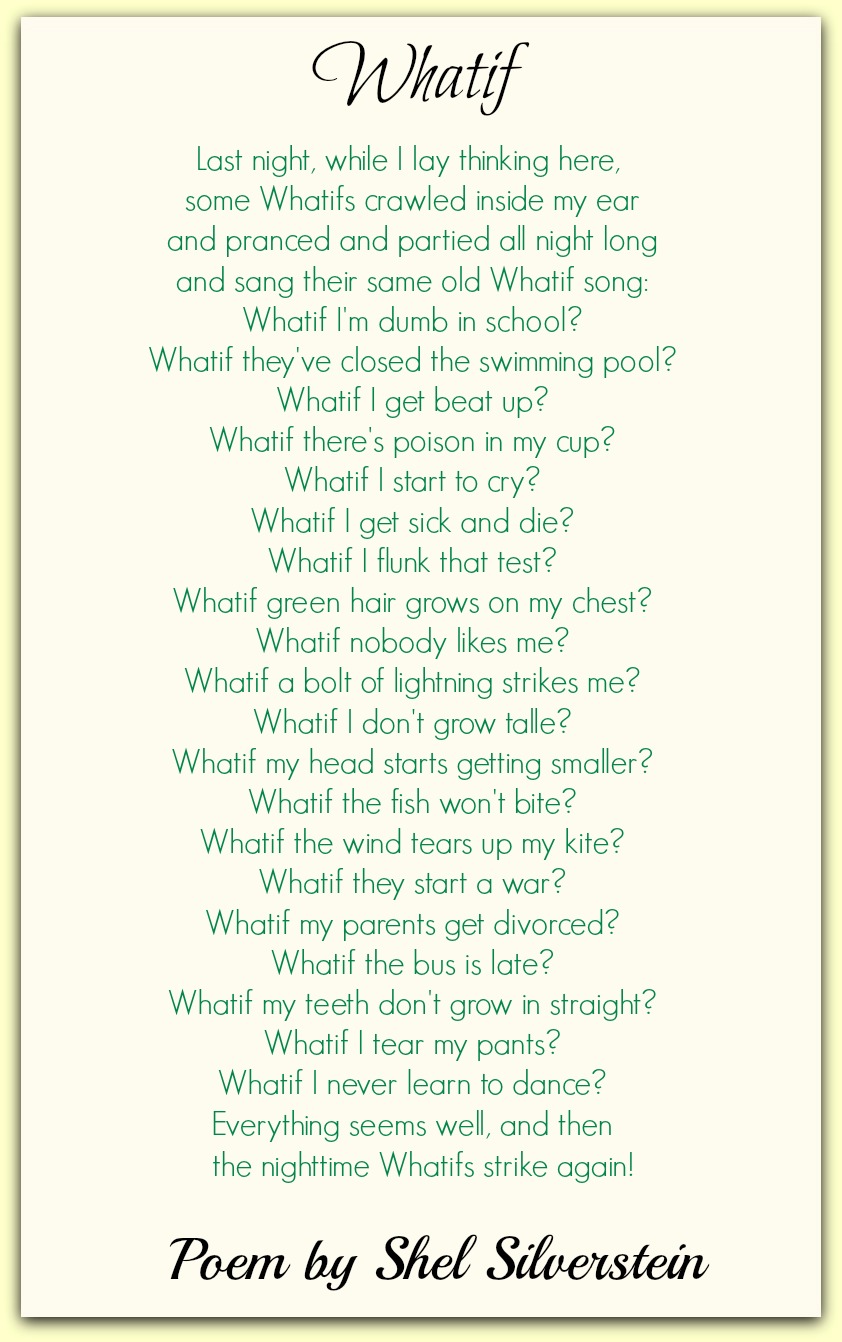
But really, what if (or “as if” as Cher from the movie Clueless – see above – might say)? If I were going to teach alternative historical fiction to my incoming eighth graders, I would introduce the theme by reading Shel Silverstein’s poem “what if?” and inquire how our lives are similar or different from the scenario in the poem. What did they like? What is missing? What matters? What is realistic? Why do we spend time contemplating these questions? I would then ask them to brainstorm some events from our world today through the lens of “what if,” and having students consider how our lives would be different (not necessarily better) if events had happened differently than how we know them today.  I am sure the list would surprise most adults.

In 2019, when the buzz word is 21st Century Learning, education cannot exist without considering the “what ifs” in our world. What if the kids tank the state assessment? What if my students aren’t engaged when I’m observed? What if my students aren’t safe in my classroom? What if students no longer have time to read at all? Critical thinking and alternate solutions drive the what ifs. So how do we as educators and librarians feed the what ifs? We provide literature by authors who may have already wrestled with the solution and can offer insights into the question students have asked. As Summers (2019) stated, a solution to those questions “tends to come out through the authors perspective and their beliefs and just their thoughts on why something happened the way it did” (SCHL 5200 Podcast June 2019); when students read these selections, the likelihood of additional what ifs abound, leading to more reading. What could we recommend? What guidance can we offer?

Luckily, young adult (YA) authors have taken the what if question to new heights by crafting literature which seeks to answer those questions under the genre of dystopian novels. The genre of dystopian novels provides potential solutions to a bevy of questions or problems which could exist in our world today. In her article on “Dystopian Fiction for Young People: Instructive Tales of Resilience,” researcher Kerry Mallan (2017) reminds us how dystopian fiction serves two functions: “On the one hand, it offers readers an opportunity to reflect on their current existence to compare the similarities and differences between the real and the fictional; on the other, these stories implicitly exhort young people to take responsibility for their own lives and the future of society” (PSYCHOANALYTIC INQUIRY, p.16). Helping students see their world with more clarity and perhaps take responsibility for solving their own problems is priceless. Having those solutions come from reading a fictional account in a dystopian text is money in the bank – or in this case, a library.  When selves at local book shops are swollen with self-help books, stakeholders and community members would be foolish not to support the genre of dystopian fiction in a school library because they almost function in the same manner and research supports it.  If more support is needed, stakeholders and administrators need only look to Jen Scott Curwood’s (2013) research on “affinity spaces” which are generated from reading dystopian fiction. In her article “The Hunger Games: Literature, Literacy, and Online Affinity Spaces,” Curwood defines affinity spaces as “physical, virtual, or blended spaces where people interact around a common interest or activity (Gee, 2004)” (p. 417). It is in these affinity spaces directly derived from dystopian novels where readers can “respond positively to creative, multigenre responses to literature that are shared with an authentic audience” (p. 423). This sense of belonging, of finding a like-minded community, a squad, or a tribe, encourages young readers to continue reading and begin participating in different discourse online.  The creativity stemming from affinity spaces and dystopian novels could easily be the door for adding a makerspace to a library. Curwood also says an affinity space could also be the ticket to engaging “reluctant readers and voracious readers alike” (p. 418) because “the affinity space encourages young people to read, critique, and reinvent young adult literature” (p.425), and that is never a bad idea.

What if a school decided to press on with the idea of having more dystopian fiction in the library and offering them to classroom teachers? What if the library offered to set up affinity spaces for students to participate in, create, or program additional spaces? Downsides do exist and the first is teacher reluctance. One challenge Curwood highlights is the shift in content instruction. She says, “[teachers] may need to let go of some of their instructional practices that no longer effectively motivate and engage adolescent learners. If our aim is to motivate students as readers and writers, we need to provide them with entry points into the curriculum, much like portals serve as entry points to an online affinity space” (p.425), the library may very well be the place to host and foster this change.

What if in the world of 21st Century Learning, schools, communities, and libraries celebrated alternative historical fiction by offering children and young adults a wider array of dystopian fiction. What if students used these literature selections to freely participate or create affinity spaces where they can engage in discourse with other like-minded individuals? What if test scores went up as a result of this creative, independent outlet? What if we teachers just “trust[ed] ourselves” by “listen[ing] to our students” (Curwood, p. 426) to validate their needs, interests, and learning styles?

References

AriellaB. (2013, January 8). Clueless As If [Video file]. Retrieved from https://www.youtube.com/watch?v=VpVoUvLdErw

Curwood, J. (2013). The hunger games: Literature, literacy, and online affinity spaces. Language Arts, 90 (6), 417-427. Retrieved from http://www.jstor.org.aurarialibrary.idm.oclc.org/stable/24575002  

Mallan, K. (2017). Dystopian fiction for young people: Instructive tales of resiliencePsychoanalytic Inquiry, 37(1), 16–24 http://dx.doi.org/10.1080/07351690.2017.1250586

Nature Poems. (2015). Timeless Shel Silverstein Poems. Retrieved from https://www.nature-poems.com/timeless-shel-silverstein-poems.html

Summers, L. (2019, June 23). Introduction to week 3: Alternate historical fiction. SCHL 5200 E50. University of Colorado Denver. Podcast retrieved from https://ucdenver.instructure.com/courses/419107/pages/week-3-agenda?module_item_id=1874023

Book Review #1 Multicultural Selections

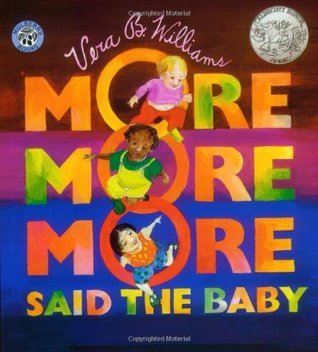
Age 4 – 8: More, More, More! Said the Baby written and illustrated by Vera B. Williams. A Caldecott Honor Book. Publisher: Greenwillow Books. New York, NY. 1990. 29 Pages. Cost: $9.66 Hardcover (Amazon).  ISBN: 0-688-09174-1

On the back cover of this Caldecott Honor Book jacket, Vera B. Williams (1990) says she was inspired to write this book because she “attained grandmother status” (More, Jacket Cover).  When I purchased this children’s book for my son almost 30 years ago, I didn’t see it as a multicultural book. It was the sweetest declaration of love written by a grandma who saw her grandbabies as the best parts of her life. In fact, when I read this to my young son, his response was that beautiful monosyllabic word, “more.”

Young readers will enjoy listening to the simplicity of the language and storyline coupled with the colorful choices in the illustrations. The relationships we encounter in this book are clearly multicultural. As Williams introduces readers to “Little Guy, Little Pumpkin, and Little Bird,” parents will see how Williams has managed to include a variety of babies, their family members, and their delights in things other than food or toys. The movement in Williams’ illustrations are subtle but priceless. The sheer joy in the babies’ faces elicits nothing buy joy from the readers/listeners. In the end, Williams has created a book that leaves readers wanting more.

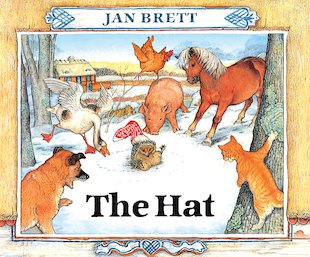
Age 9-11: The Hat written and illustrated by Jan Brett. Publisher: G.P. Putnam’s Sons. New York, NY. 1997. 28 Pages. Cost: $16.95 (USA) $22.95 (CAN). ISBN: 0-399-23101-3

If you’ve ever lost a sock in the dryer, then The Hat (1997) is the book for you!  The Hat follows Hedgie, the Hedgehog, who was lucky enough to “find” a sock that fell off the clothesline. Hedgie struggles to get rid of the sock on his head but not before the other animals on the farm see him. He first encounters the mother hen who laughs at him before asking what is on his head. To hide his embarrassment, Hedgie boldly announces, “Why it’s my new hat” …” Isn’t it beautiful?” (p. 7). The mother hen doesn’t respond; she just cocks her head and runs off with an idea. Hedgie continues to struggle to get this sock off his head, meeting a new animal with each struggle and each animal laughing at him. Will Hedgie ever get the sock off his head? The Hat speaks to being the first brave person to try something new that may look silly but is actually a good idea. The ending has a fun surprise that reveals the message of acceptance and inclusion. If you have a hedgehog, maybe you didn’t lose your sock to the dryer. Maybe your hedgehog is just a fashion trendsetter!

Brett’s book will delight children in early elementary grades who may have a hedgehog as a class pet who will immediately understand the antics of such a small animal. Those who don’t have a hedgehog may clamor for a class or home pet since Hedgie is depicted as cute beyond cuteness. Hedgie’s has some great qualities which could spark great discussions with elementary students. He is first embarrassed by his situation, but then determined and tenacious to solve the problem. The illustrations are also beautiful and demure. Brett has created a continuum in the animal Hedgie will encounter next as each watch Hedgie’s tribulation.  These animals show the same curiosity a librarian might see on students’ faces in a read aloud – what is happening and what will happen next?

I was lucky enough to meet Jan Brett, author and illustrator of The Hat, when she visited a local bookstore.  I brought my eight-year-old son to meet her, and she graciously signed and illustrated his copy of The Hat, which he still treasures today. Having read The Hat again after so many years, it makes sense to put this book in a multicultural category according to the definition provided by the NationalAssociation of Independent Schools (NAIS). NAIS “defines diversity with the term “otherness” and states that diversity “is determined by race, gender, and culture. On a more subtle level, it includes class, sexual orientation, religion, ability, and appearance.” (https://www.nais.org/articles/pages/diversity-and-multiculturalism-147595.aspx (Links to an external site.) Hedgie’s inadvertent choice of headgear gives him an appearance of otherness, and while the animals laugh and jeer at him at first, their acceptance of him with his headwear shows the animals “breaking down the … barriers of equality and justice” (NAIS Website). It’s a beautiful book with a wonderful message.

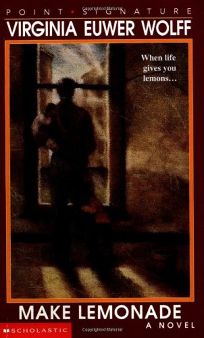
Age 12 – 14: make lemonade by Virginia Euwer Wolff. Publisher: Point Signature a division of Scholastic, Inc. New York, NY. 1993. 200 Pages. $17.07 Paperback (Amazon). ISBN: 0-590-48141-X

“When life gives you lemons…make lemonade.” This novel is a story about two young girls, LaVaughn and Jolly, who need each other and the lessons each learns in the process of getting that help. LaVaughn is fourteen and wants to go to college. (Her mother will see to it that she does.) LaVaughn wants to earn some money to help get herself there, so she answers an ad for a babysitter. Jolly has two babies; Jeremy is two and Jilly is a “gooey baby” (p. 6).  At seventeen, Jolly is struggling, “I can’t do it alone no longer, see, I’ll get fired, it’s a good job…” (p. 7).  Virginian Euwer Wolff (1993) writes this book that sounds like the prose one might lift from a diary. The voice, like the setting and characters, is authentic, honest, and brutal. Readers can hear LaVaughn’s fourteen-year-old self telling us this story. It is hers, after all. The simplicity of this stream-of-consciousness voice is powerful because we get to hear the honesty of LaVaughn’s situation – she isn’t sure about what she’s doing, but she knows she has to help. As LaVaughn says, “Other people would maybe tell it different but I was there” (p.3). This novel may require a permission slip – not for inappropriate language but for the realistic portrayal of the details. Seeing poverty set in this way will be an eye-opener for unprepared readers. The reality of a seventeen-year-old with two babies is timely and disturbing. The theme of helping someone rise out of their lot in life is expertly written.

This novel provides readers with a view of how poverty and lack of education combine to create some dire economic struggles that come with making choices. The idea that a seventeen-year-old girl with two babies will not seek assistance from government programs because she doesn’t want to lose her children is both honorable and foolish. The struggles Jolly endures because of her choices is heartbreaking, but admirable. The fact that LaVaughn sees her education as her ticket out of a potentially similar situation is huge. Most children who live in poverty have heard that education is their ticket out – can LaVaughn make it? Will she help Jolly get her education AND keep her babies?

make lemonade is Wolff’s first novel in a trilogy. The other two novels, True Believer and This Full House follow LaVaughn in her quest to go to college and the obstacles she faces just being a teenager from a disadvantaged area. The challenges she has grown up around rear their ugly heads again in these two novels, but their message is clear. Education is the ticket out.

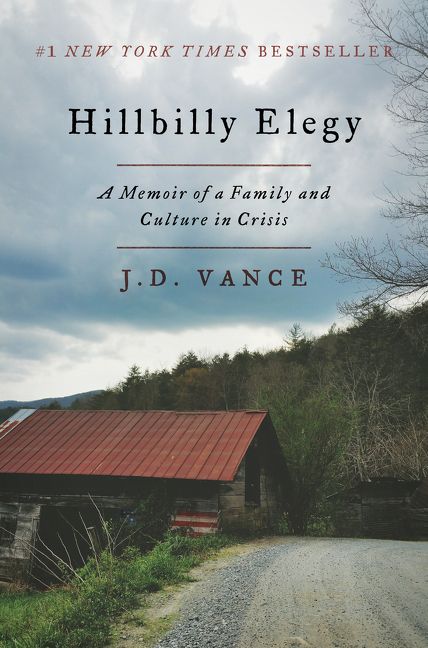
Age 15+   Hillbilly Elegy: A Memoir of a Family and Culture in Crisis by J.D. Vance. Publisher: Harper Collins. New York, NY. 2016. Digital Edition Published May 2018. 273 Pages. $10.74 (Amazon Prime) $11.99 Kindle Edition). Digital ISBN: 978-0-06-287225. Print ISBN: 978-0-06-230055-3

In his introduction, J.D. Vance (2016), author of Hillbilly Elegy, writes “… I didn’t write this book because I’ve accomplished something extraordinary. I wrote this book because I achieved something quite ordinary, which doesn’t happen to most kids who grew up like me” (p. 1).  Vance continues to tell us his statistics: he was poor from the Rust Belt in Ohio, had a “complex relationship” with his parents, and grandparents who never finished school (p. 2).  He mentions the “grim future” he faced but then reveals his accomplishments – a lawyer who graduated from an Ivy League School: Yale. As his memoir unfolds, Vance takes readers on a journey with the same twists and turns one might find in the back woods of rural Kentucky. Jackson, Kentucky that is. Readers will laugh and cry with the voices Vance introduces us to: Mamaw with her harsh, no nonsense, salty language; Papaw who is the only ‘stable’ father figure Vance will ever know;  Bev, his addicted mother, and the string of male ‘fathers’ she provided for her children; we meet Lindsay, his sister, who took on the role of the responsible adult when it was necessary; and we’ll meet the village of people who helped Vance reach his goal of rising up and out of his “grim future.”

This memoir falls into the multicultural literature genre because Vance allows readers into the world of the Scots-Irish from the Appalachia area (p.3). He introduces readers to the diverse culture he emerged from in Middletown, Ohio which included race and religion and the social culture he had to learn to adapt to in New Haven as a Yale law student. Vance crafts a personal narrative embedded with data and statistics on poverty and the working white class – so the memoir reads as non-fiction in places. He says, “my primary aim is to tell a true story about what that problem feels like when you are born with it hanging around your neck” (p.8). The power in this memoir comes from the stark reality painted in the painful, personal recollections Vance shares with readers. White working-class poverty is an ugly truth few have seen poised so vividly. Readers will understand Vance’s message early and thoroughly – no one gets along in this world without a little help from others. He is profoundly grateful for the people in his life who guided his journey, even, and perhaps, especially, those people who taught him what not to do and how not to behave in life.

Mature high school readers of this memoir may require a permission slip for the salty language and certain sexual situations described. Adult readers will have to suspend what they think they know about hillbilly culture. Not all hillbillies are created equal, and Vance does a good job explaining why this is so with personal examples and hard data to back him up. The politics in this memoir may also upset some readers, but Vance shows how politics and culture don’t always go hand in hand. Hillbilly Elegy is a must read for students and educators alike who want to expand their definition of how multiculturalism does not depend on color alone.

References

Brett, J. (1997). The hat. New York, NY: G.P. Putnam’s Sons.

National association of independent schools (n.d). Diversity and multiculturalism. Retrieved from https://www.nais.org/articles/pages/diversity-and-multiculturalism-147595.aspx

Williams, V.B. (1990). More, more, more! Said the baby. New York, NY: Greenville Press.

Wolff, V.E. (1993). make lemonade. New York, NY: Point Signature, a Division of Scholastic, Inc.

Vance, J.D. (2016). Hillbilly elegy. New York, NY: Harper Collins.

BLOG #2: Magic in the Classroom

In Christopher Emdin’s (2014) TEDTalk called “Teach teachers how to create magic,” Emdin’s call to action is for teacher education programs to require teachers to go into communities to familiarize themselves with the learners they want to engage. He says pre-service teachers should go visit the barbershops and churches and even asks teachers to take notes on teaching engagement strategies from rap concerts. Emdin’s point is that teachers who plan to teach in urban schools do not know how to engage their students and becoming a sage on the stage will bridge the gap.

In his book, For White Folks Who Teach in the Hood…and the Rest of Y’all Too: Reality Pedagogy and Urban Education, Emdin (2016) introduces readers to the term “neoindigenous” to describe urban youth of color. Neoindigenous is a term coined by Emdin based on the

“United Nations Declaration on the Rights of Indigenous People which defines indigenous people as people whose existence in a certain geographical location predates the region’s conquering or occupation by a colonial or imperialist power, and who see themselves as, or have been positioned as, separate from those who are politically or socially in command of the region” (pp. 7-8).

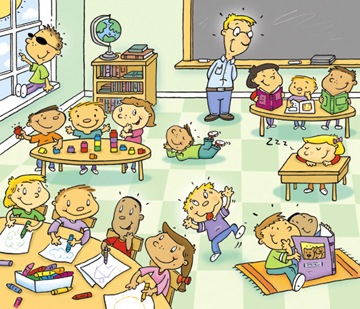
“Cartoon Classroom.” Creative Commons Image. https://debosmita.files.wordpress.com/2010/04/classroom.jpg

Emdin asserts that pre-service teachers must see urban youth of color as “neoindigenous” since these youth have shared experiences of being oppressed by a dominant group. Emdin builds his argument when he claims that unprepared “white folks” silence neoindigenous youth by denying their voices which “showcase[e] their culture in vivid, visceral, and transgressive ways” (p. 12) thus effectively rendering urban youth as invisible. His argument is that pre-service teachers or teachers who anticipate working in urban schools with youth of color must engage in “Culturally Relevant Pedagogy” to successfully engage students before begining the business of educating neoindigenous students because their reality is vastly different from typical students in traditional classrooms.

One of the most positive aspects Emdin outlines in these early chapters is the idea of creating a classroom culture where “educators … create safe and trusting environments that are respectful of students’ culture” (p. 27).  Because my teacher education program understood the concept of reality and culturally relevant pedagogy, I was well-prepared to teach students of color – whatever color that happened to be. To this day, I do not begin my class without first gauging the temperature of my class. That is who are they, what matters to them, what are they interested in, and why should I care. Although my students were not all from challenging homes or disadvantaged environments, they all understood the concept of respect as a two-way process.

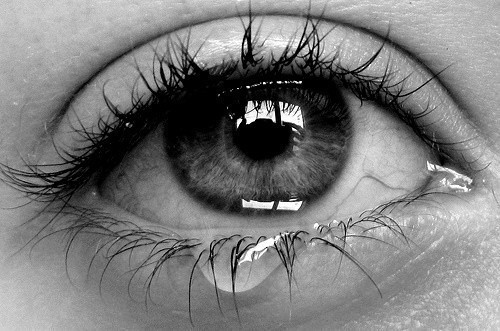
“Crying Eye Girl Sadness” Creative Commons Image http://s3.favim.com/orig/46/crying-eye-girl-sad-sadness-Favim.com-424109.jpg

The example used in chapter 1 of the teacher who expected the student to be prepared was a vivid exemplar of how miscommunication occurs and how disrespect is viewed by students. When the student cried in the principal’s office because she did not or could not articulate her side of the story because she felt silenced was eye-opening. Had this teacher taken the time to respectfully speak to her student, the situation may not have escalated like it did. I am lucky to have a robust teacher toolbox when it comes to building relationships with my students.

I am looking forward to reading the rest of this book to enhance my already strong teacher toolbox.

References

Cartoon classroom image (n.d.). Retrieved from Bing Image Search. Found on https://debosmita.files.wordpress.com/2010/04/classroom.jpg Retrieved on June 21, 2019.

Crying eye girl sadness image (n.d). Retrieved from Bing Image Search.  Found onhttp://s3.favim.com/orig/46/crying-eye-girl-sad-sadness-Favim.com-424109.jpg Retrieved on June 21, 2019.

Emdin, C. (2016). For white folks who teach in the hood…and the rest of y’all Too: Reality pedagogy and urban education. Boston: Beacon Press.

TED. (2014, April 8). Emdin, C. Teach teachers how to create magic  TEDxTeachersCollege. [Video File]. Retrieved from https://www.youtube.com/watch?v=H3ddtbeduoo&feature=youtu.be.

BLOG #1: Literacy Philosophy

Defining literacy has become a challenge in recent years because our world has changed so much since the advent of technology. Once upon a time, being literate simply meant a person could read and write. Fast forward to 2019, and literacy has taken on a whole new identity. In 2019, not only does literacy mean being able to read and write, it also means being able to discern the emojis teenagers use to respond to texts.  

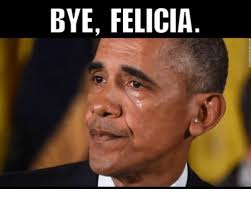
Today, being literate also means understanding the nuances in the memes posted on social media walls – was it supposed to be funny? Sarcastic? Amusing? Mean? And who’s is Felicia, anyway?

A pound key or pound symbol, which was also known as a number sign (#), now goes by the name hashtag – #latenightpottymouthwarning

#Hashtag” with Jimmy Fallon & Justin Timberlake (Late Night with Jimmy Fallon)

and without the ubiquitous @ symbol, email goes nowhere and no one can locate us on the “gram.” Does this qualify as literacy? In 2019, it absolutely does, as much as keeping track of Snapchat streaks counts as math.

Jesting aside, today’s definition of literacy is more than just knowing how to read and write. Literacy includes comprehension and understanding, critical thinking, and decoding. It’s not enough to know how to read, but also to practice that skill; likewise, it’s not enough to know how to write, but also to write for specific purposes, to and for specific audiences, and make some meaning in that writing – synthesize material, argue, persuade, inform, or call to action. Today’s literate community must still practice proper grammar and punctuation because language conventions are still appropriate and have not lost their prestige. I recently read The 57 Bus (2017) by Dashka Slater and realized that using preferred pronouns will be a new tool I must add to my literacy toolbox.  Additionally, style and tone also play significant roles in our messages, and audience awareness is key to ensuring the right message gets to the right person/people. Given that we are also more visual in our literacy journeys, appropriate images can make or break our stories. A colleague recently mentioned The Book With No Pictures (2014) by BJ Novak which challenges young readers to employ a different kind of literacy, albeit age appropriate.

Our children must also be able to see themselves in the writings put before them. To be literate also means to connect with the words on the page on a personal level. This is the most important role our children’s and Young Adult literature has. Rich characters that resonate with readers create important connections; without these connections, literature can alienate readers – of all ages – the experience is lost no matter how great the story. My sophomore honors English students who read J.D. Salinger’s The Catcher in the Rye (1951) said they didn’t understand why it was still on the banned books list because the events and language in the novel were no longer taboo.

Our libraries and the literature they house must remain places where readers can find themselves, not just physically but also emotionally, socially, academically, and personally.  

References

Fallon, J., & Timberlake, J. (2013). #Hashtag with Jimmy Fallon and Justin Timberlake (Late Night with Jimmy Fallon). Retrieved June 11, 2019, from https://www.youtube.com/watch?v=57dzaMaouXA

#Hashtag is a parody of the overuse of the tagline

Little Day Out. (2017). Seven fun facts about emojis in honour of world emoji day. Retrieved from https://www.littledayout.com/2017/07/15/seven-fun-facts-emojis-honour-world-emoji-day/. Retrieved June 12, 2019.

The Dab Emoji is the most requested and wanted emoji at emojirequest.com.  

MEME. (n.d.) Barack Obama Bye, Felicia. meme. Retrieved from https://me.me/i/bye-felicia-7642007. Retrieved June 12, 2019.

Even the President of the United States is not immune to being posted in a Meme generator parody.  

Novak, B.J. (2014). The book with no pictures. New York, NY: Dial Books for Young Readers.

Salinger, J.D. (1951). The catcher in the rye. Boston, MA: Little Brown and Company.

Slater, D. (2017). The 57 bus: A true story of two teenagers and the crime that changed their lives. New York, NY: Farrar, Straus and Giroux (BYR) – A Division of McMillian.