This last round of book reviews was a calculated choice. Since I am headed to a school that is going to focus on computer science and coding, I elected to read books with that theme in mind. I have to say I was pleasantly surprised at the many books out there for a variety of ages which focus on coding. One of my selections has a title that is misleading, but I was able to fit it in just the same. I hope you enjoy my selections.

“SMALL PROBLEM #1: FIND A PLACE TO BUILD” (p.7)
Age 4 – 8: how to CODE a sand castle written by Josh Funk; illustrated by Sara Palacios; foreword by Reshma Saujani, founder of Girls Who Code. Publisher: Scholastic, Inc. New York, NY. 2018. 33 Pages. Cost: $11.57 softcover (Amazon Prime). ISBN: 978-1-338-54690-3
Since summer is just about over, this book is timely – how DOES one code a sandcastle? Well, we need sand and that means we also need a beach. Okay so what next? In Josh Funk’s book, we follow Pearl who has been trying all summer to make a sandcastle, but flying frisbees, sharks, and a piddling (literally) puppy ruin her attempts. On the last day of summer break, Pearl comes up with a brilliant idea. She enlists the services of her “trusty, rust-proof robot” (p. 5) named Pascal to build her sandcastle. Although Pearl gives Pascal instructions, she soon learns Pascal needs VERY specific instructions. He needs to be told when to start and stop, how long and how deep to dig, and she learns that repeating herself is exhausting, so she creates LOOPS to help her quit repeating herself. Using a series of solving Small Problems, Pascal builds Pearl’s perfect castle, even decorating it by using If-Then-Else statements because Pascal takes what he sees since he hadn’t been told he couldn’t. When Pearl’s perfect castle is finished, she’s ready to play, but the ocean has other ideas. New problem, so back to step one. Luckily, since Pearl kept her code, she can just add a SEQUENCE to it to solve that last pesky problem. Pearl learns that she can always change her code to new solve problems that pop up, and that gives her some amazing power. Will she write code for other things?
Some of the hallmarks of this book are the cheerful, colorful, sunny, optimistic, and happy illustrations created by Sara Palacios. Pearl never gets overly upset or defeated when her code doesn’t work as she wrote it. She just keeps plugging away, and Palacios’ illustrations perfectly depict the setbacks. Josh Funk gives us a story about perseverance and critical thinking in action. This uplifting story demonstrates why we have to back to tinker and revise until we achieve the desired results. That Pearl is a female protagonist will speak to all the young code writers out there to keep doing what they’re doing. Trial and error are a must for writing code. The book also provides some important vocabulary that will help students understand the story better and will ultimately help them with their own code writing.
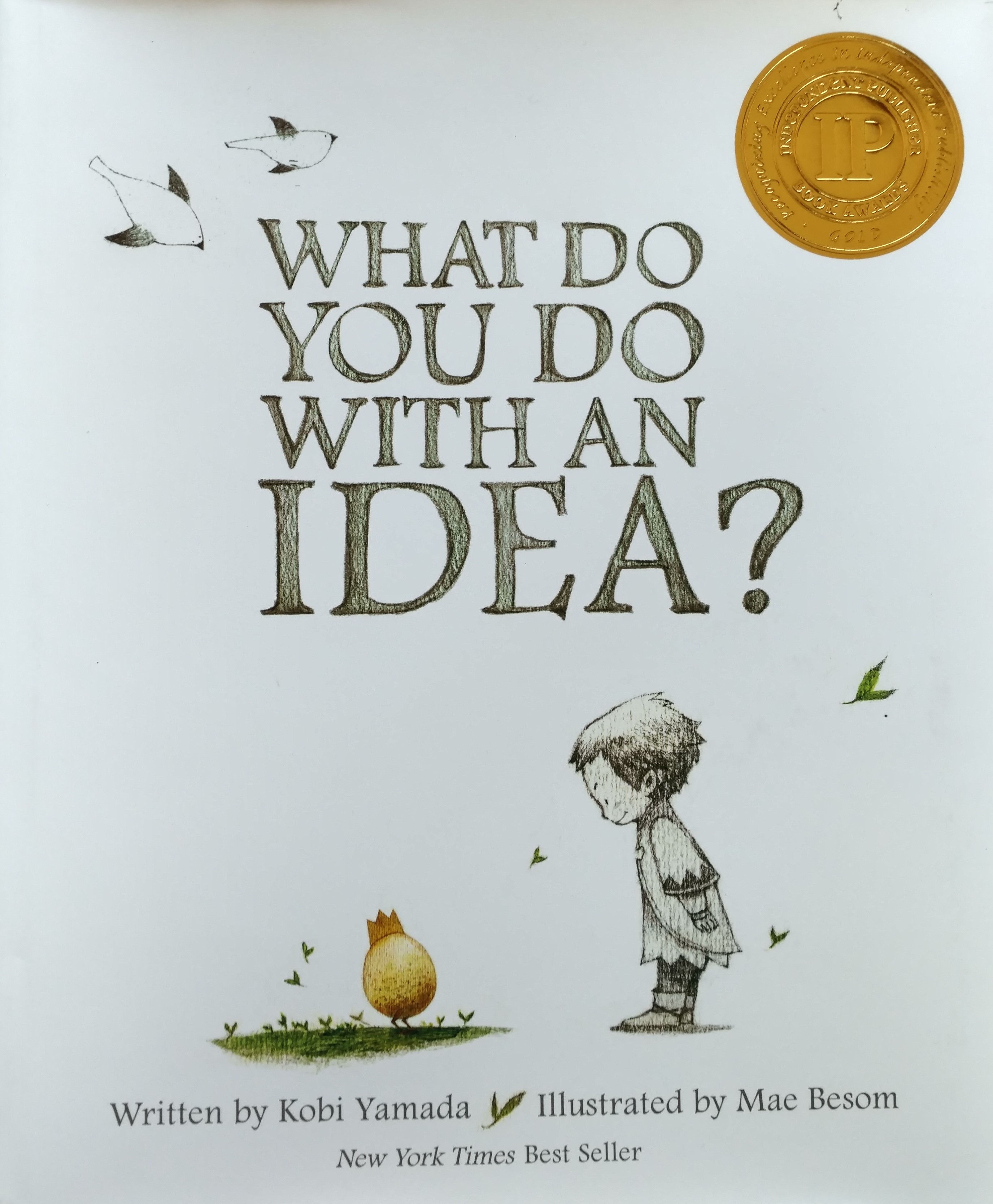
“…there was something magical about my idea. I had to admit, I felt better and happier when it was around.” (p.10)
Age 9-11: What do you do with an idea? Written by Kobi Yamada; illustrated by Mae Besom. Independent Publisher Book Award: Recognizing Excellence in Independent Publishing – Gold Winner. Publisher: Compendium, Inc. Seattle, WA. 2013. 34 pages. Cost: $10.61 Hardcover (Amazon Prime). ISBN: 978-1-938-29807-3
I selected this book for this age group because it is sweet and the illustrations are beautiful. However, right on the dust cover, this book proclaims, “This is a story for anyone, at any age, who’s ever had an idea that seemed a little too big, too odd, too difficult” (Yamada), and it is the truth. I selected this book because I wanted to have a story to share with students who have great ideas but don’t know what else to do with them. Like my high school students (who might also enjoy this book) who come up with great ideas, but then don’t know how to make them come to life because they allow other people to color their ideas into nothingness. They do this by asking everyone else what they think of the idea and then their own thoughts get lost in the shuffle, and the original idea goes nowhere. So too does the unnamed protagonist in this book, until he decides to trust himself. What becomes of his idea in the end is a testimonial to perseverance. Our ideas, all of them, good, bad, and otherwise, just want some life, some attention. In fact, when we believe in our ideas, they help us to see that “it is good to have the ability to see things differently” (p. 26). Kobi Yamada has crafted a truly lovely message in this book, and Mae Besom produced some illustrations that complement the theme perfectly. The pages look as though the originals were created on rough textured paper using charcoal or pencils and water colors. At first, the colors selections are subtle graphite, pale greens, and warm yellows. As the story progresses, the colors include soothing blues and hints of crimson. By the time the book comes to a close, Besom incorporates more color and fuller images on the pages, but the tones are very subtle and organic. The minimalistic images on the page at the beginning of the book mimic an idea that hasn’t quite fully developed and become more robust as the story progresses. In an art class, this would be a great example of how to use the whole page (what every art teacher asks students to do), without using the whole page. It would also be a great study in perspective and movement because the images start in one corner and flow out across both pages showing where the idea is headed. From a design perspective, this is a great example of layout because sometimes the illustrations occupy one half of the page with text housed in the other half, and on other pages, the format is flipped. Finally, as the idea in the book becomes more possible, the image representing the idea grows in size. When I was shopping for this book, I found an ‘idea’ like the one in the book I could purchase. It could be used as a tool for discussion – when you have the idea in our hand, you get to speak and others must listen.
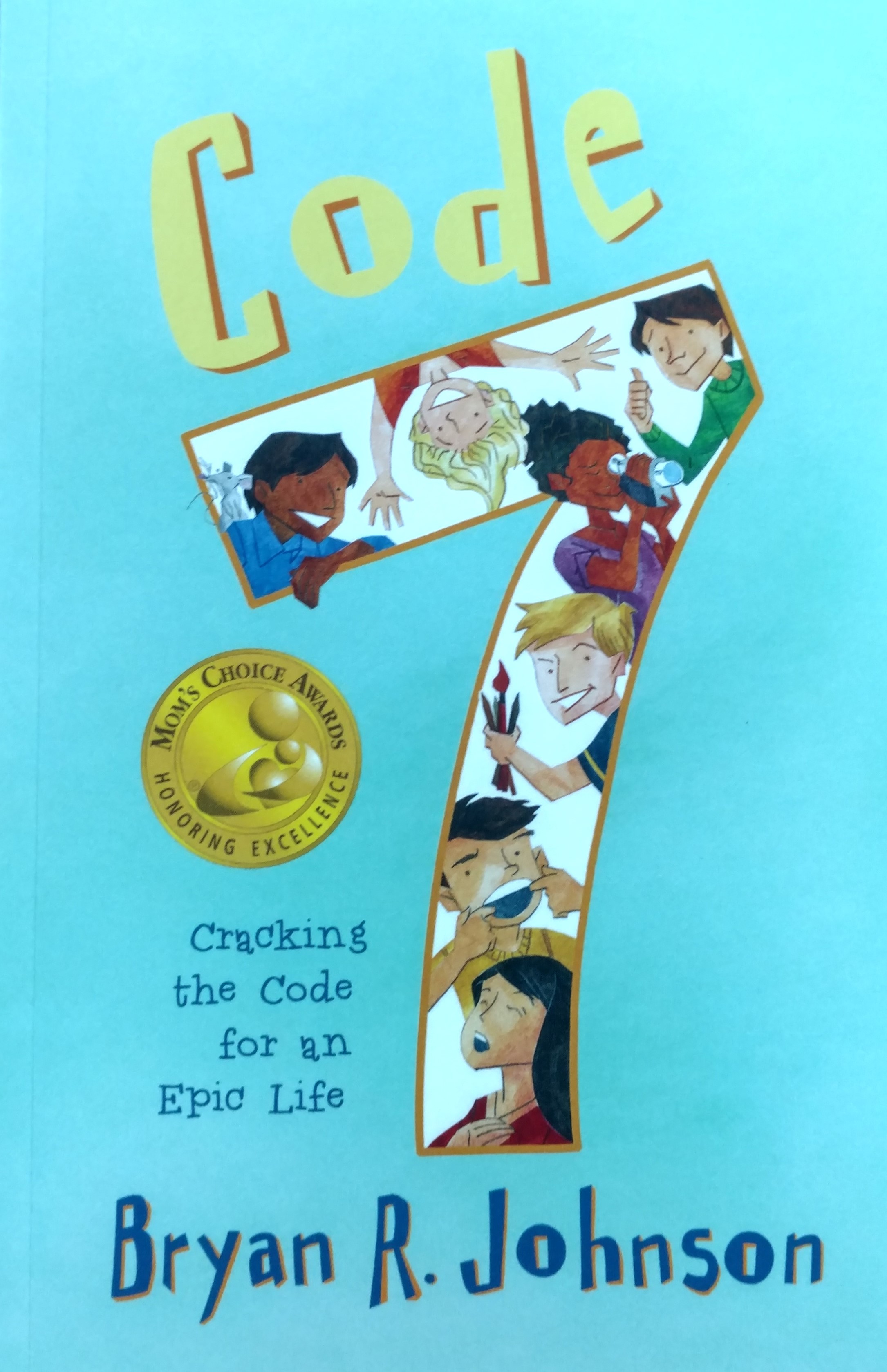
Dear Reader,
You are invited to crack a code – one that will put you on the path to lead an epic life. Read this book closely. The code is composed of seven important words, and if you learn to live by them, you will be prepared to become what you desire.
Bryan Johnson (back cover)
Age 12 -14: Code 7: Cracking the Code for an Epic Life by Bryan R. Johnson. Mom’s Choice Awards – Honoring Excellence. Publisher: Candy Wrapper, Inc. Chicago, IL. 2017. 104 Pages. Cost: $12.97 (Amazon Prime). ISBN: 978-1-940556-00-0
In his book, Code 7, Bryan R. Johnson introduces readers to seven students who are trying to navigate the world of pre-teen/teen issues. Although I selected this book because I thought it was about coding, it has nothing to do with code writing, BUT it does have to do with cracking a “code” of sorts to navigating the world of teen angst: responsibility, courage, perseverance, honesty, creativity, bullying, and trust. Each student will learn something about him/herself that will make his/her life more complete. Readers will meet Jefferson, Sebastian, Genevieve, Talmage, Samantha, Alec, and Kaitlyn who all attend Flint Hill Elementary and have different talents and skills. The seven stories Johnson crafted for readers involve some kind of social or emotional skills students must learn at some point in their development. The first five stories were typical, believable situations many students face in school. The sixth story “Oh, rats!” (p. 77), however, made me cringe and had the parent in me saying “No way would I let my kid so that!” Alec is used to having his parents take care of everything for him, including cleaning his room. One day, they decide to stop doing it to teach him a lesson. Alec’s room gets so out of hand, the local authorities have to step in. Johnson clearly took a huge dive with authorial privilege in this story. I had to work hard to suspend my reality with this one because I’m sure no parent would allow the situation to go as long as it did, but maybe I’m wrong. The final story involves all the characters in Kaitlyn’s story. Together, the students learn that they can make a difference, but sometimes power comes thru collaboration rather than individual efforts. The message is one worth reading.
At the end of the book, Johnson invites readers to join the Code7 Crew via his website www.code7book.com. He provides a free 75-page discussion and activities download for his book. The activities are great and would be ideal for those social emotional lessons. He has included a variety of activities for each story in the book. On the website in the section called ‘Members,’ group members have submitted their photos with a placard that shows the code word they have chosen to live by. In this section, Johnson provides links to two websites to help students of all ages find ideas and resources for making an impact on their worlds – real impacts. I love empowering youth to follow their passions and help them “find their tribes” of like-minded people who share that passion. The book was great, but the websites he sends students to is better. Check out www.fuzzyplanet.com and www.startswithus.com, they are worth the clicks.
While this book might be too young for this target age group, it could be used for reluctant readers or ELL students because the language is simple and clear, but the situations teeter on upper elementary into middle school/junior high.
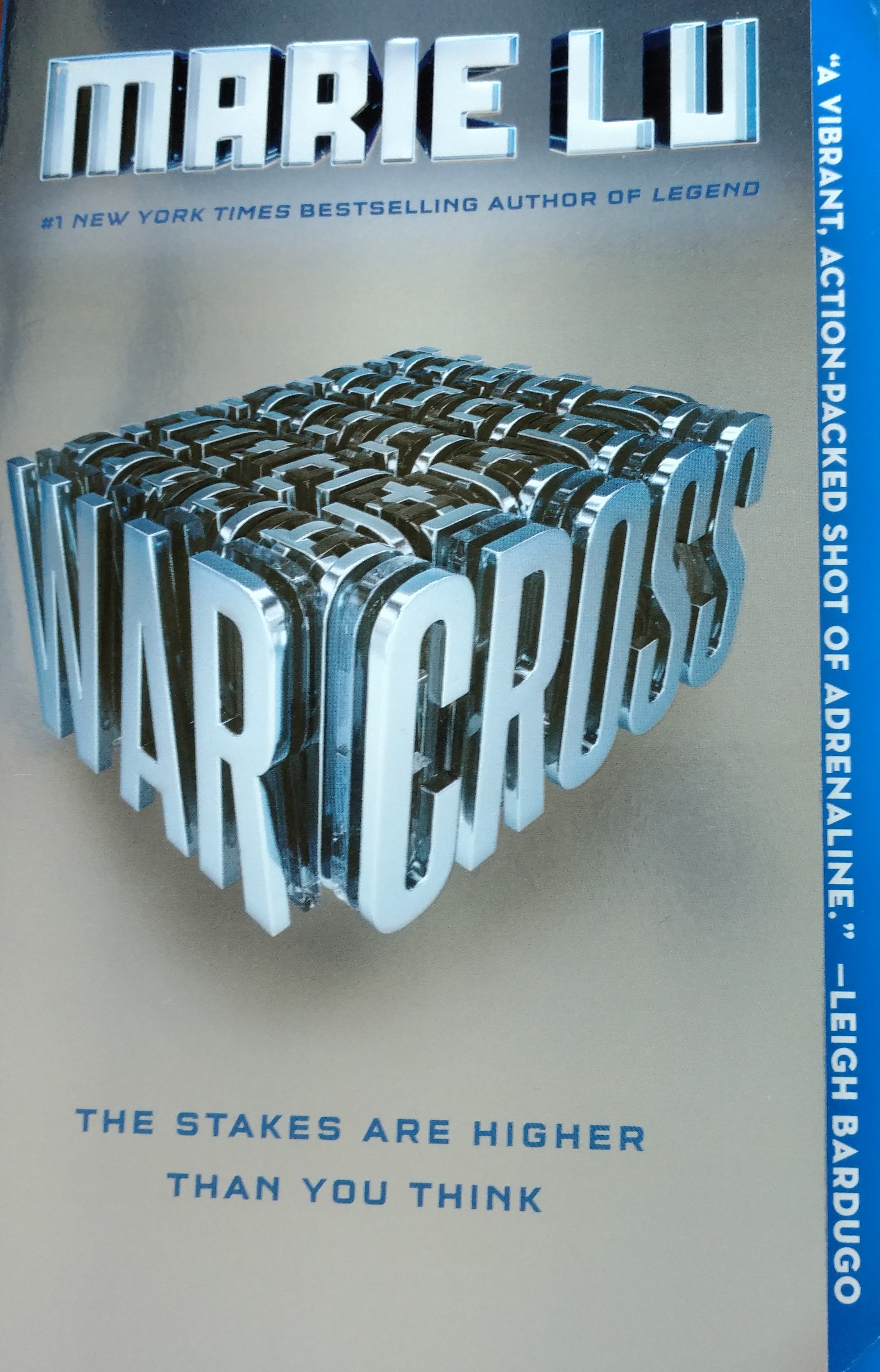
“This is not how I want everyone in Warcoss to know me – the girl who glitched into a game out of sheer stupidity, then got into the Wardraft as a wild card because my stunt got me written in” (p. 108).
Holy cow! Marie Lu has created a fabulous technology novel featuring a heroine who codes, hacks, gives sass, has a heart of gold, falls in love (sort of), and kicks some serious virtual world video game butt. In Warcross, Lu takes readers into the world of Henka Games, brainchild (no pun intended) of Hideo Tanaka, which is part Quittich, part Alien, part Blade Runner, and part something else. This fast paced, video game hacking world of Emika Chen is one she needed to be in but one where she got more than she bargained for.
Chen is a hacker with world-class skills who starts out in New York City as a bounty hunter finding criminals for the police in hopes of earning some fast cash. Since her financial stability is shaky, owing more money than she has and facing a certain eviction, Chen decides to “accidentally” hack her way into the most important video game of the year as an anonymous player at the opening ceremony of the championship game. Now, for readers who are not familiar with EASports (and their venue in Vegas) and to better understand the magnitude of this championship, think of the coverage and hype leading up to the Super Bowl. While some viewers may not even be interested in the game, they WILL know all about the players, including stats and personal information, training and level of play, team history, and the pressure to win. Set mostly in Tokyo, the Warcoss championship is THE game to attend and everyone around the world is watching. Enter Hideo Tanaka, the 21 year old technology phenom with rock star good looks and a healthy bank account, who created Warcoss and the Neurolink glasses that everyone uses to link into the game, and it is easy to see how the lights, glamour, and technology associated with his empire is nothing short of Vegas during any of the typical championship games in the United States.
Lu’s novel takes readers into the world of gaming, coding, hacking, and the Dark World associated with technology. In her character development, Lu gives us the mysterious Hideo Tanaka, the stoic young entrepreneur with a past full of secrets; she pairs him with Chen as the surprise heroine with rainbow colored locks whose past is an open book, including her time in “juvy” for taking a stand for someone who was bullied. That’s who she is – she stands for others who cannot stand for themselves. A smart, powerful, critical thinking, independent female – until she meets her teammates, Chen learns how to rely on all of their collective skills. Her father taught her that there is always a solution, you just need to find the right key. This novel reads like a screenplay in the making – no really, I could see this as a full-fledged film blockbuster. I even had some songs in mind to include for the soundtrack including Meghan Trainor’s “Me Too,” Billie Elilsh’s “Bad Guy,” and Ruth B’s “Peter Pan.” This novel was a nice blend of computer coding and hacking, gaming environment excitement, the drama of friendship building, intrigue of a mystery, a little romance, amazing and scary technology tools, and the “bad’ guys all rolled into one. As Lu introduces each character, she builds their complexities and they become more significant as the novel progresses. One of the most important themes in the novel is teamwork. After a particularly difficult challenge in the plot, Hammie, on of Chen’s veteran teammates says, “You remind me of myself from several years ago. I was always offered help – but I refused to accept any. My mother scolded me about that. Do you know what she told me? When you refuse to ask for help, it tells others that they also shouldn’t ask for help from you. That you look down on them for needing your help. That you like feeling superior to them. It’s an insult, Emi, to your friends and peers. So don’t be like that. Let us in” (p. 292). This critical message is a turning point for Emika Chen and sets up the resolution for this novel and the sequel.
With all the new technology embedded in the story line, tabloids are still a problem in this futuristic world – in fact, the photos are broadcast instantaneously for all the world to see. While I placed this novel in the YA category, the romance scenes could be a concern. Although Lu never says the couple consummates their relationships, she handles the scene with the subtle stoicism and class a man with Tanaka’s discretion would take knowing how far reaching his image would be plastered if the tabloids discovered it.
This novel was a great red for readers looking for a powerful female computer coder/hacker heroine. It speaks to the value of learning not only from people but also from mistakes and getting back up again despite set-backs. I enjoyed it very much and the teaser for the next installment in the series called Wild Card.
References
Funk, J. (2018). how to CODE a sand castle. New York, NY: Scholastic, Inc.
Johnson, B. (2017). Code 7: Cracking the code for an epic life. Chicago, IL: Candy Wrapper, Inc.
Lu, M. (2017). War cross. New York, NY: SPEAK, an imprint of Penguin Random House LLC.
Yamada, K. (2013). What do you do with an idea? Seattle, WA: Compendium, Inc.




 Educating Edis