“What if…” is the beginning of the most powerful question in the English language. It offers opportunities and helps people view situations differently. In literature, the lens of “what if” takes shape under the genre of alternative historical fiction. For those of us not well-versed in the term alternative historical fiction, consider it this way: what if Tesla won the electricity war instead of Edison? What if Shakespeare didn’t write his plays and poems? What if Lee Harvey Oswald killed Jacqueline Bouvier Kennedy instead? What if Hillary Rodham Clinton became the first female President of the United States? What if SpongeBob was collected for research by a well-intentioned marine biologist? (Not sure that episode hasn’t already been written, but maybe.) What if ALL the Disney theme parks suddenly closed? What if ants carried machine guns? (Okay, that last question came directly from my seventh-grade Texas history teacher, Mr. Ruttman, who answered my questions (and all of the ones he had no answer for) with that one to get me to “simmer down, young lady.”)
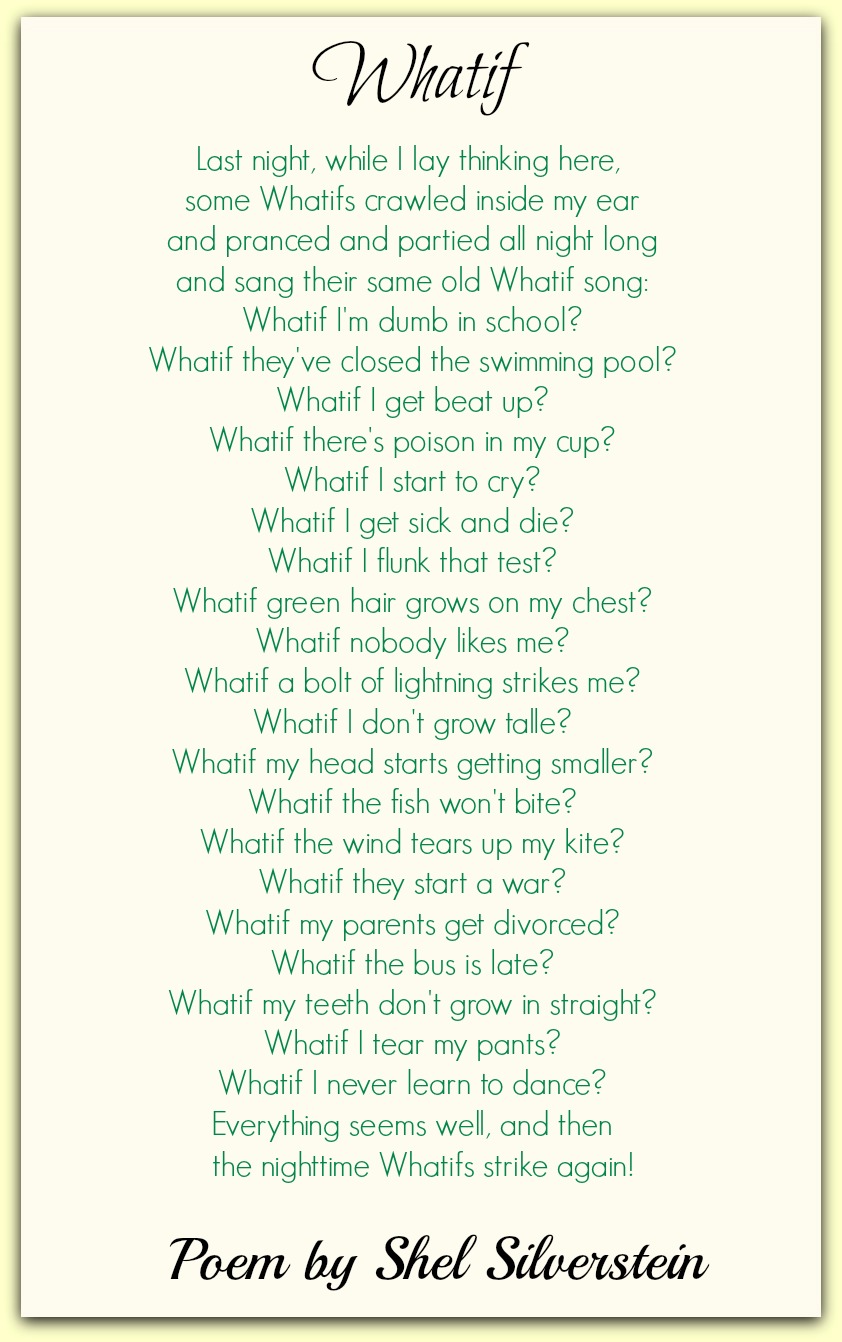
But really, what if (or “as if” as Cher from the movie Clueless – see above – might say)? If I were going to teach alternative historical fiction to my incoming eighth graders, I would introduce the theme by reading Shel Silverstein’s poem “what if?” and inquire how our lives are similar or different from the scenario in the poem. What did they like? What is missing? What matters? What is realistic? Why do we spend time contemplating these questions? I would then ask them to brainstorm some events from our world today through the lens of “what if,” and having students consider how our lives would be different (not necessarily better) if events had happened differently than how we know them today. I am sure the list would surprise most adults.
In 2019, when the buzz word is 21st Century Learning, education cannot exist without considering the “what ifs” in our world. What if the kids tank the state assessment? What if my students aren’t engaged when I’m observed? What if my students aren’t safe in my classroom? What if students no longer have time to read at all? Critical thinking and alternate solutions drive the what ifs. So how do we as educators and librarians feed the what ifs? We provide literature by authors who may have already wrestled with the solution and can offer insights into the question students have asked. As Summers (2019) stated, a solution to those questions “tends to come out through the authors perspective and their beliefs and just their thoughts on why something happened the way it did” (SCHL 5200 Podcast June 2019); when students read these selections, the likelihood of additional what ifs abound, leading to more reading. What could we recommend? What guidance can we offer?
Luckily, young adult (YA) authors have taken the what if question to new heights by crafting literature which seeks to answer those questions under the genre of dystopian novels. The genre of dystopian novels provides potential solutions to a bevy of questions or problems which could exist in our world today. In her article on “Dystopian Fiction for Young People: Instructive Tales of Resilience,” researcher Kerry Mallan (2017) reminds us how dystopian fiction serves two functions: “On the one hand, it offers readers an opportunity to reflect on their current existence to compare the similarities and differences between the real and the fictional; on the other, these stories implicitly exhort young people to take responsibility for their own lives and the future of society” (PSYCHOANALYTIC INQUIRY, p.16). Helping students see their world with more clarity and perhaps take responsibility for solving their own problems is priceless. Having those solutions come from reading a fictional account in a dystopian text is money in the bank – or in this case, a library. When selves at local book shops are swollen with self-help books, stakeholders and community members would be foolish not to support the genre of dystopian fiction in a school library because they almost function in the same manner and research supports it. If more support is needed, stakeholders and administrators need only look to Jen Scott Curwood’s (2013) research on “affinity spaces” which are generated from reading dystopian fiction. In her article “The Hunger Games: Literature, Literacy, and Online Affinity Spaces,” Curwood defines affinity spaces as “physical, virtual, or blended spaces where people interact around a common interest or activity (Gee, 2004)” (p. 417). It is in these affinity spaces directly derived from dystopian novels where readers can “respond positively to creative, multigenre responses to literature that are shared with an authentic audience” (p. 423). This sense of belonging, of finding a like-minded community, a squad, or a tribe, encourages young readers to continue reading and begin participating in different discourse online. The creativity stemming from affinity spaces and dystopian novels could easily be the door for adding a makerspace to a library. Curwood also says an affinity space could also be the ticket to engaging “reluctant readers and voracious readers alike” (p. 418) because “the affinity space encourages young people to read, critique, and reinvent young adult literature” (p.425), and that is never a bad idea.
What if a school decided to press on with the idea of having more dystopian fiction in the library and offering them to classroom teachers? What if the library offered to set up affinity spaces for students to participate in, create, or program additional spaces? Downsides do exist and the first is teacher reluctance. One challenge Curwood highlights is the shift in content instruction. She says, “[teachers] may need to let go of some of their instructional practices that no longer effectively motivate and engage adolescent learners. If our aim is to motivate students as readers and writers, we need to provide them with entry points into the curriculum, much like portals serve as entry points to an online affinity space” (p.425), the library may very well be the place to host and foster this change.
What if in the world of 21st Century Learning, schools, communities, and libraries celebrated alternative historical fiction by offering children and young adults a wider array of dystopian fiction. What if students used these literature selections to freely participate or create affinity spaces where they can engage in discourse with other like-minded individuals? What if test scores went up as a result of this creative, independent outlet? What if we teachers just “trust[ed] ourselves” by “listen[ing] to our students” (Curwood, p. 426) to validate their needs, interests, and learning styles?
References
AriellaB. (2013, January 8). Clueless As If [Video file]. Retrieved from https://www.youtube.com/watch?v=VpVoUvLdErw
Curwood, J. (2013). The hunger games: Literature, literacy, and online affinity spaces. Language Arts, 90 (6), 417-427. Retrieved from http://www.jstor.org.aurarialibrary.idm.oclc.org/stable/24575002
Mallan, K. (2017). Dystopian fiction for young people: Instructive tales of resilience. Psychoanalytic Inquiry, 37(1), 16–24 http://dx.doi.org/10.1080/07351690.2017.1250586
Nature Poems. (2015). Timeless Shel Silverstein Poems. Retrieved from https://www.nature-poems.com/timeless-shel-silverstein-poems.html
Summers, L. (2019, June 23). Introduction to week 3: Alternate historical fiction. SCHL 5200 E50. University of Colorado Denver. Podcast retrieved from https://ucdenver.instructure.com/courses/419107/pages/week-3-agenda?module_item_id=1874023
 Educating Edis