“Librarians are literary superheroes who combat censorship and battle villains that use their cynicism and biases to restrict access to information.” –from Graphic Novels: A brief history and overview for library managers
Graphic novels and comic books were never really on my radar when I was growing up and learning to read, so they haven’t been a genre I gave much thought to until now. Honestly, I had forgotten all the great cartoons I loved reading in the newspaper on Sunday: Breathed’s Bloom County, Watterson’s Calvin and Hobbs, and Garry Trudeau’s Doonesbury, but I do not think I ever classified them as books. Like many skeptics believe, they were just cartoons, intended to entertain me with color and cute characters. Mad Magazine and Archie’s comics which WERE staples in my home were treated with very little reverence. In a family with seven children, the older readers devoured each comic book and had to tape them back together to preserve them for the younger readers to enjoy. I was second to last, so they came to me in sad shape. I still didn’t think these were books with much merit – they were funny (when I was able to get the jokes) and the artwork was colorful and clever.
When I became a middle school teacher with a 6th
grade homeroom, Bill Watterson was at the height of his career with Calvin
and Hobbs, and many of my students aspired to be just like Mr. Watterson. They
were less familiar with Berkley Breathed, who gave life to Opus T Penguin in Bloom
County, so it was my duty to introduce them to each other. Of course, I would
be remiss if I failed to mention the priceless talents of Klasky, Germain, and
Csupo, the creators and animators of Nickelodeon’s Rugrats. Who could
resist these talented cartoonists and foundational graphic novelists? Not my students.
Today, comics and graphic novels have earned a place on the
shelves in most school and public libraries. Pinkley and Casey (2013) remind
us that “graphic novels have not only appeared in libraries and bookstores, but
have become an integral part of popular culture and a vital aspect of the
literary community” (p. 1) because they appeal to a variety of elements: the complex
or simple artwork; color choice: multicolor or black and white; simplicity of
the story; visual sequence of the plot as it unfolds before the reader. The
choices are abundant and rich.
If I were to assign graphic novels, comics, or media, (and
the likelihood that I will teach this in the fall is strong), I would start
with some history on the genre because it took a long time to be recognized as
a genre of its own. In fact, most of the authors of this week’s readings have driven
home the point but disagree on when the first graphic novel was the first to
achieve that status. Without arguing who is right or wrong or first, I would
ask students to look at the elements in the selected reading materials. Using
the viewpoint of consumers, I would urge my students to see what is happening
on the page in terms of thesis and anti-thesis. For example, what words (or
lack of words), color (or lack of color), plot, theme, or artwork style is the
author using. Why were these choices selected for this particular topic? Could something
else worked instead? When authors and artists make these choices, who are they
looking to hook? Why? How would this work be different if the target audience changed?
I would want my students to see beyond the pages in front of them to decipher
the critical components in these works. I have no doubt students today could
easily articulate their choices because they are visual learners, and as Karp
(2011) suggested “contemporary students have a much wider visual vocabulary than we did
growing up, I contend that the format offers great opportunities to teach as
well as to entertain” (The Case for Graphic Novels in Education website). In
fact, I would not be surprised if students offered additional materials for
comparison because they have been exposed to this genre since they small
children.
Since these are the books that fly off the shelves and
have the longest waiting lists in circulation, most librarians would agree that
graphic novels, comics, and media maintain their resilience because “they
contain meaningful themes and allow readers of all ages to develop critical
thinking, learn visual literacy, and improve comprehension and literary
interpretation skills” (Pinkley and Casey, “Graphic novels,” p.1). These are
the so-called ‘soft-skills’ students need in all areas of education that drive critical
thinking and encourage students to become active participants in their
education rather than just passively “sit and get” course content. I would
argue that when stakeholders (administrators, parents, and community members)
see the impact this genre has on readers of all ages, they would be more likely
to support additional acquisitions for libraries. It’s a powerful genre, and
one that won’t likely die away anytime too soon, given the visual nature of our
technological world. Our students are already invested in visual materials on
the Cartoon and Nickelodeon networks, with shows such as Rick and Morty, Archer,
or SpongeBob, so it only makes sense to bring in printed materials they
love. Learners who are actively engaged with materials they love, who can
articulate the elements involved in themes and messages, who question what is
on the page, and who appreciate the value of the materials offered for their
consideration become life-long learners, and isn’t that the ultimate goal of
education?
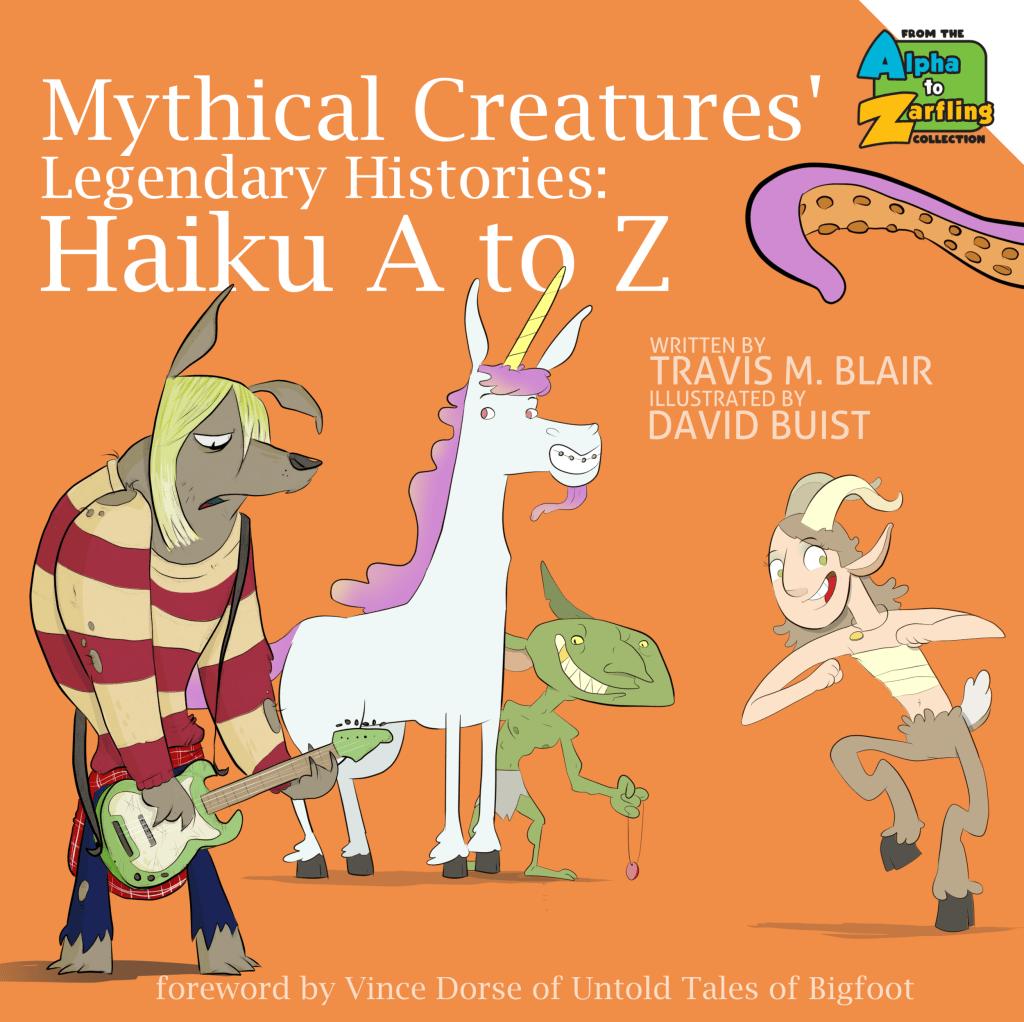
Age 4 – 8: Mythical Creatures’ Legendary Histories: Haiku A to Zwritten by Travis M. Blair; illustrated by David Buist. Foreword by Vince Dorse of Untold Tales of Bigfoot. From the Alpha to Zarfling Collection. Publisher: Zarfling Platoon. Lexington, KY. 2018. 29 Pages. Cost: $9.50 Softcover (Amazon). ISBN: 978-1-7326982-1-5
The first time I ever heard the term “liger” was in the movie Napoleon
Dynamite. Napoleon was drawing a liger and said “It’s pretty much my favorite animal. It’s like a lion and a
tiger mixed… bred for its skills in magic” (Quote.net). It’s one of my
favorite lines from the movie. As teachers, we know students can conjure some
great combinations of creatures; we also know many students struggle with
writing poems. Like mythical creatures, Travis Blair (2018) has twisted these concepts
in his children’s book.
Using the haiku method to introduce
each creature, Blair treks through the alphabet showcasing 26 different mythical
creatures accompanied by a poem. The drawings are not terribly sophisticated,
but their simplicity is their appeal: they are colorful and funny – his zombie
is dressed like Michael Jackson: “ZOMBIE – Dead, yet is alive! / An insatiable
hunger / Bites make more undead” (p.26). The challenge for me was to find something
appropriate for readers this age which would fit the alternate
history/dystopian category, but I really like what Blair does by blending a
high-brow form of poetry (haiku), typically presented with beautifully serene
images, and dumps it on its head with is kid-friendly content. Blair provides three
great take-aways in his book: the lesson on haikus at the beginning, the world map provided near the end, so students
can see a cultural connection to their favorite mythical creature and perhaps
do a little more research (I didn’t know unicorns came from Asia!), and the
questions he offers on the last page so students to create their own mythical
creatures. Blair bends popular culture in a tongue and cheek fashion by blending
popular culture references in his illustrations (could his werewolf be Michael J.
Fox from Teen Wolf?) and makes haiku poetry more accessible and less
intimidating. Students will enjoy creating their own mythical creatures and
then writing haiku poems about them after reading this book.
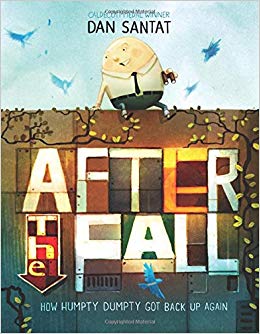
Most students should be familiar with nursery rhymes by the targeted age group (9-11), but do students know the origin of those nursery rhymes? Or better yet, what happens after the rhyme is over? Do Bo Peep’s sheep actually come home wagging their tails behind them? What about Humpty-Dumpty? He sat on the wall, had a great fall, but no one could put him back together again, or so that’s what we’ve learned. That’s it? Really? Where’s the sequel? Dan Santat, author and illustrator of After the Fall gives us the “rest of the story” as Paul Harvey might have said to those of us who want to know. After the Fall follows Humpty to the wall to tell us why he was there in the first place and how he fell, to the hospital and the heroic efforts of the king’s men (who do put him back together) “Well, most of me” (p. 4) he tells us, back to the scene of the accident. Yes, it was an accident. Although he is repaired, the scars no one can see are the focus of this book. Using beautiful images in muted tones with close-up perspectives and accessible language for students this age, Santat shows readers how obstacles can stop us from doing what we want as well as the work and courage it takes to get back up again, like Humpty does – no spoiler alert – it’s in the title. The message is clear – we may fall, but we CAN get back up again. This book champions a variety of social-emotional lessons: how to overcome obstacles or conquer negative mindsets, sympathy and empathy discussions, effects of PTSD, or just give students a much-needed self-esteem boost. It would also be a great example of writing alternate endings or creating alternate histories for nursery rhymes. Why did Little Jack Horner have to sit in a corner? What did his mother say about his utensil choice? Your thumb, Jack? Seriously?
Some final praise for After the Fall: Santat’s book cover
and interior illustrations are superb, but it was the dust cover that reeled me
in. The dust cover might appeal to readers on a variety of levels: the
industrial look is visually pleasing – a little rugged, a little soft, and a
little sheen – the title letters are raised giving the cover a tactile component,
and his use of block style, imperfect lettering is something students in this
age range could easily mimic. The red down arrow, blue birds and pale blue sky,
green vines, and Humpty’s jeans all serve to paint a positive outlook for the story
even before a reader opens this book. After the Fall was selected as a
Caldecott Medal Winner, and it is easy to see why.
“If you had some dangerous qualities, your parents could dampen them” (p. 47) …to “keep kids safe and to help them succeed” (p. 48).
Image from Amazon.com
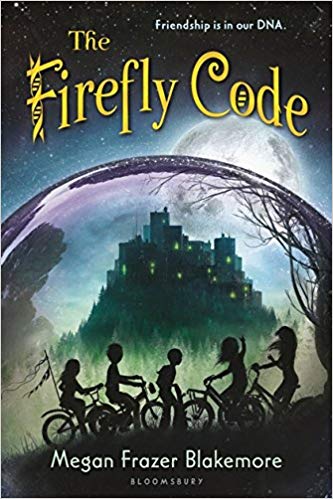
Age 12 – 14: The Firefly Code: Friendship is in
our DNA by Megan Frazer Blakemore. Publisher: Bloomsbury. New York, NY. 2016. 338
Pages. $16.99 Hardback (Amazon). ISBN: 978-1-61963-636-1
For just about every young person, turning 13 is a pivotal time
because it is the official start to the teen years! Many cultures celebrate
this milestone with a party, but what if when you turned 13, you not only get a
fabulous party to celebrate your milestone, but you also get to find out your
special talent – you know the one that will determine your future – your pathway
– your latency? Oh sure, some latencies show up naturally, like drawing well or
socializing, and of course, you can be tested, but you won’t get results until
you turn thirteen. For the friends in The Firefly Code, Mori, Julia,
Theo, and Benji, turning thirteen not only means finding out their special
talent, it is also the time to find out who contributed to their DNA. “People
can either be natural, which is the old-fashioned way; with genetic material
from the mom and the dad. Or they can be designed, which means that their DNA
was cloned or modified, either because one of the parents had genetic or
fertility problems, or because they just wanted more of a say in how their kids
turned out” (p.6). In the first of two books in this series, Megan Frazer
Blakemore (2016) writes about what it means to be an outsider, an insider, and
a true friend. Everything these emerging young adults believe in will be
challenged. Theo declares early in the novel that he wants to pursue puzzles
and problem solving, while Mori, the daughter of scientists, wants to do
something with visual memory. Their cookie-cutter community, where everyone does
essentially the same thing for the same reasons (except for the genetically
modified children), is about to be shaken up when new neighbors move in. How
will Krita, the major employer in Old Harmonie whose core values are “creativity,
ingenuity, experimentation, and order” (p.6) deal with the changes? Can the
community and friends handle the non-technology approach to life that Iliana
craves? Will the four friends weather the storm of unanswered questions they uncover?
Blakemore incorporates modern technology into this YA novel
that will appeal to many young readers – self-driving cars, watches that store health
data, meal-delivery service, and genetic modifications on both the positive and
negative sides. The medical testing to find out latency is more physically
challenging than a standardized test, but the results happen earlier. Similarly,
if a child shows some unpleasant behaviors, he/she could be subject to “dampening”
which was “the opposite of latency. If you had some dangerous qualities, your
parents could dampen them” (p. 47) …to “keep kids safe and to help them succeed”
(p. 48). The characters all discuss ways they can solve problems using
technology – they are living the four pillars of the Krita corporation. Blakemore
also uses numerous nature and conservationist references in this novel. For
example, Mori planted three trees in her neighborhood to make it more unique;
she loves flowers – Gerber daisies (p.41), specifically; and her family practices
composting and recycling with verve. These aspects provide the nature/nurture
piece for readers. One downside, and it’s a small one, is the dialogue. The
grown-up dialogue from the pre-teen and teen characters was not what I expected
to hear, so suspending some belief is necessary. Our narrator, Mori, is only
twelve, but she lives in a futuristic, technology driven world, so that could
be the reason the dialogue is elevated. The medical details are also quite
sophisticated which could throw off some readers.
Overall, this is a great little book for YA readers. It will
bring up some great discussions about friendship and how asking the harder
questions often brings about some needed answers.
There are three parts to learning: information, knowledge, and wisdom. A mere accumulation of information is not knowledge, and a treasure of knowledge is not, in itself, wisdom. (Caine, p.46)
Image from Amazon.com
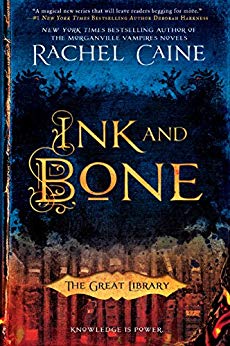
Age 15+ Ink and Bone (The Great Library Book 1) by Rachel Caine. Publisher: Penguin Group. New York, NY. 2016. Digital Edition Published May 2015. 354 Pages. Cost: $1.99 (Kindle Edition) Digital ISBN: 978-0-698-18081-9
“A man cannot be reduced to paper, to lines and letters! He
cannot be consigned to a shelf! A life is worth more than a book! Vita
hominis libro valet!” (p.34), so writes Rachel Caine (2015) in her novel Ink
and Bone (The Great Library Book 1). As Caine’s story unfolds, the
characters who revere learning, knowledge, and wisdom learn that books hold a
much higher value in this world where The Great Library has supreme power in 2041.
While librarians and educators might cheer (as I did, at first), books, in this
novel, lead to clashes between nations, altar human dignity, drive people to
deceptive behaviors, and, in some cases, murder. All because books are THE
priority.
This novel reminded me of the Harry Potter series,
where young people take on the weight of their world and solve problems. Caine,
however, creates characters who not only love books and want to serve their
countries, they also have the desire to change to world. This book follows the journey
of Jess Brightwell, who “had grown up a smuggler, understanding that books were
a precious commodity, understanding that his family catered to a basic human
hunger” (p. 137) to his “forced” quest in service with The Great Library (a noble
position). Jess loves to read and has great respect for the written word, but
written words get him in trouble. Tested,
then carefully selected, 30 postulates travel to Alexandria, Egypt “the first
place in the world to encourage common people to read and learn. The first to
educate without regard to status, creed, sex, or religion” (p. 55) for
training, but only six will be offered positions with The Great Library. Who
will survive? The postulates undergo lessons and tests like those on Survivor
or in an escape room – figure out the puzzle and live. Hesitate and pull a tile
that determines elimination from the program.
The pace of the novel starts off slowly, but like a roller
coaster, takes readers on an up and down journey which keeps readers riveted to
the page (or device). Caine creates a world where readers will easily connect
to the technology and devices her characters use. A CODEX sounds like our current
smartphones, while ‘blanks’ sound much like a Kindle or reading device. Jess
prefers real books to a blank because “a blank is a poor, pale imitation,
though the words are arranged in precisely the same order; it is the difference
between an idea and a physical thing, legal or not” (p.58). Of course, we do
not yet have translation chambers that can transport us to a totally different
country with some ease, but there is still time. Readers may see hints of Professor
Snape of Hogwart’s fame in the character of Scholar Wolfe, shades of our military
service academies – think West Point or Air Force Academy – and their gas
chamber training; maybe even an homage to Charlie and the Chocolate Factory
in the character of Thomas Schreiber, a loveable German engineer.
The novel is chockfull of notable quotes about books,
knowledge, and wisdom. Here are some of my favorites:
…the library still held everything he’d ever wanted, too. All the knowledge in the world, at his fingertips (p. 28).
The Library holds itself to be the keeper of both knowledge and wisdom, but it is not true. So much should never be held in the hands of so few, for it is a natural, venal habit of men to hold to power. And knowledge is the purest form of power (p. 47).
The first purpose of a librarian is to preserve and defend our books. Sometimes that means dying for them – or making someone else die for them. Tota est scientia. Knowledge is all (p.62).
The reading of all good books is like conversation with the finest men of the past centuries (p. 74).
The Library doesn’t need sheep. It needs people who think for themselves. People who can stand up to a challenge (p.122).
Since this is the first book in the five-book series, Caine
leaves the door open at the end for the next novel, called Paper and Fire. One
last note of praise for Ink and Bones is the eclectic playlist Caine
provides at the end of the novel. Especially for those students who need to
have music to create their work, Caine enlightens readers to the music she used
to inspire her writing which helped me appreciate her work even more.
References
Blair, T.M. (2018). Mythical creatures’ legendary histories:
Haiku A to Z. Lexington, KY: Zarfling
Platoon.
Blakemore, M.F. (2016). The firefly code: Friendship is in
our DNA. New York, NY: Bloomsbury.
Caine, R. (2016). Ink and bone (The great library book 1). New York,
NY: Penguin Group.
Santat, D. (2017). After the fall: How Humpty Dumpty got back up
again. New York, NY: Roaring Brook
Press, a Division of Holtzbrinck Publishing Holdings Limited Partnership.
Word Art created by E.Knoop at wordart.com July 2019
“What if…” is the beginning of the most powerful question in the English language. It offers opportunities and helps people view situations differently. In literature, the lens of “what if” takes shape under the genre of alternative historical fiction. For those of us not well-versed in the term alternative historical fiction, consider it this way: what if Tesla won the electricity war instead of Edison? What if Shakespeare didn’t write his plays and poems? What if Lee Harvey Oswald killed Jacqueline Bouvier Kennedy instead? What if Hillary Rodham Clinton became the first female President of the United States? What if SpongeBob was collected for research by a well-intentioned marine biologist? (Not sure that episode hasn’t already been written, but maybe.) What if ALL the Disney theme parks suddenly closed? What if ants carried machine guns? (Okay, that last question came directly from my seventh-grade Texas history teacher, Mr. Ruttman, who answered my questions (and all of the ones he had no answer for) with that one to get me to “simmer down, young lady.”)
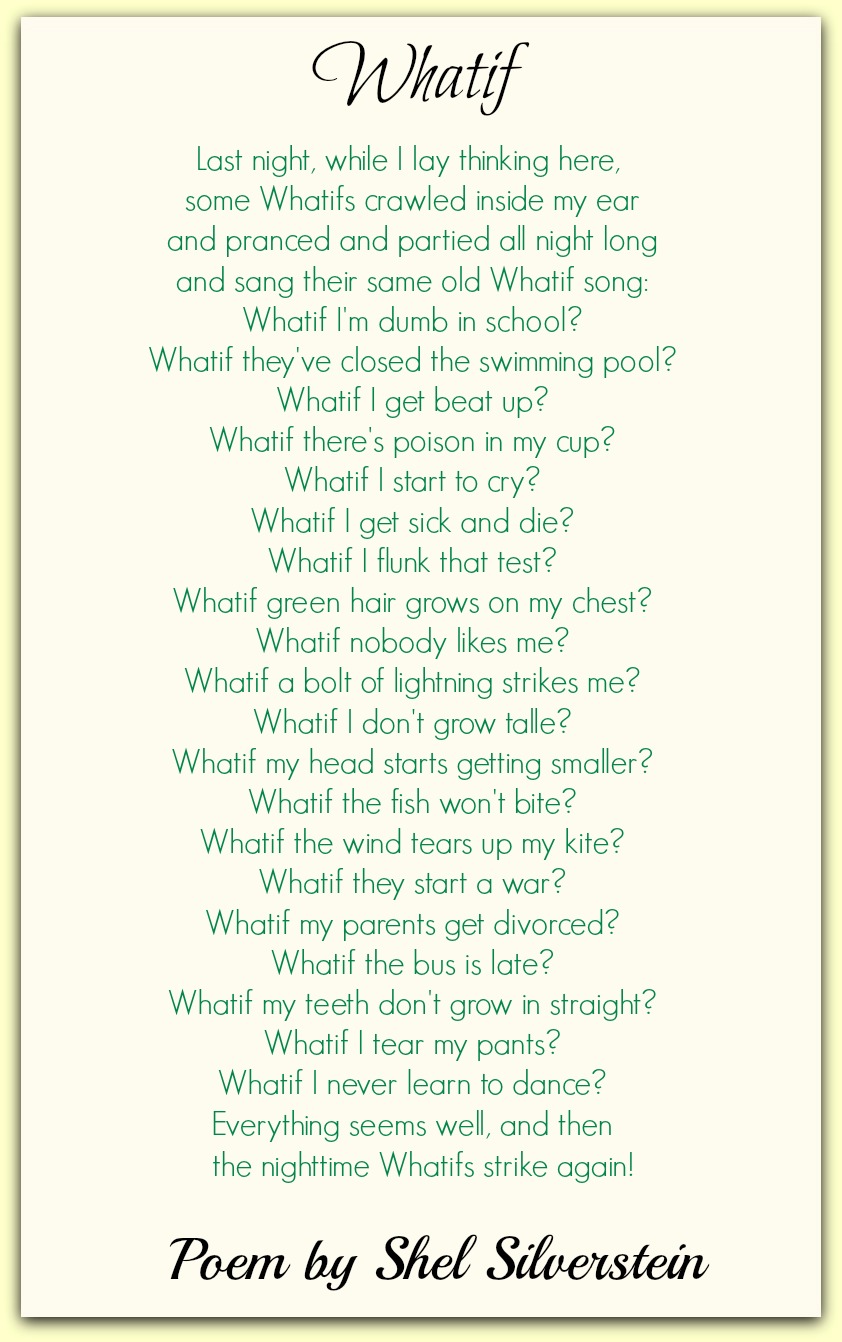
But really, what if (or “as if” as Cher from the movie Clueless – see above – might say)? If I were going to teach alternative historical fiction to my incoming eighth graders, I would introduce the theme by reading Shel Silverstein’s poem “what if?” and inquire how our lives are similar or different from the scenario in the poem. What did they like? What is missing? What matters? What is realistic? Why do we spend time contemplating these questions? I would then ask them to brainstorm some events from our world today through the lens of “what if,” and having students consider how our lives would be different (not necessarily better) if events had happened differently than how we know them today. I am sure the list would surprise most adults.
In 2019, when the buzz word is 21st Century Learning, education cannot exist without considering the “what ifs” in our world. What if the kids tank the state assessment? What if my students aren’t engaged when I’m observed? What if my students aren’t safe in my classroom? What if students no longer have time to read at all? Critical thinking and alternate solutions drive the what ifs. So how do we as educators and librarians feed the what ifs? We provide literature by authors who may have already wrestled with the solution and can offer insights into the question students have asked. As Summers (2019) stated, a solution to those questions “tends to come out through the authors perspective and their beliefs and just their thoughts on why something happened the way it did” (SCHL 5200 Podcast June 2019); when students read these selections, the likelihood of additional what ifs abound, leading to more reading. What could we recommend? What guidance can we offer?
Luckily, young adult (YA) authors
have taken the what if question to new heights by crafting literature which
seeks to answer those questions under the genre of dystopian novels. The genre
of dystopian novels provides potential solutions to a bevy of questions or
problems which could exist in our world today. In her article on “Dystopian
Fiction for Young People: Instructive Tales of Resilience,” researcher Kerry
Mallan (2017) reminds us how dystopian fiction serves two functions: “On the one
hand, it offers readers an opportunity to reflect on their current existence to
compare the similarities and differences between the real and the fictional; on
the other, these stories implicitly exhort young people to take responsibility
for their own lives and the future of society” (PSYCHOANALYTIC INQUIRY, p.16). Helping
students see their world with more clarity and perhaps take responsibility for
solving their own problems is priceless. Having those solutions come from
reading a fictional account in a dystopian text is money in the bank – or in this
case, a library. When selves at local
book shops are swollen with self-help books, stakeholders and community members
would be foolish not to support the genre of dystopian fiction in a school
library because they almost function in the same manner and research supports
it. If more support is needed,
stakeholders and administrators need only look to Jen Scott Curwood’s (2013) research
on “affinity spaces” which are generated from reading dystopian fiction. In her
article “The Hunger Games: Literature, Literacy, and Online
Affinity Spaces,” Curwood defines affinity spaces as “physical, virtual, or blended
spaces where people interact around a common interest or activity (Gee, 2004)”
(p. 417). It is in these affinity spaces directly derived from dystopian novels
where readers can “respond positively to creative, multigenre responses to
literature that are shared with an authentic audience” (p. 423). This sense of
belonging, of finding a like-minded community, a squad, or a tribe, encourages young
readers to continue reading and begin participating in different discourse
online. The creativity stemming from
affinity spaces and dystopian novels could easily be the door for adding a
makerspace to a library. Curwood also says an affinity space could also be the
ticket to engaging “reluctant readers and voracious readers alike” (p. 418)
because “the affinity space encourages young people to read, critique, and
reinvent young adult literature” (p.425), and that is never a bad idea.
What if a school decided to press on with the idea of having more
dystopian fiction in the library and offering them to classroom teachers? What
if the library offered to set up affinity spaces for students to participate
in, create, or program additional spaces? Downsides do exist and the first is
teacher reluctance. One challenge Curwood highlights is the shift in content instruction.
She says, “[teachers] may need to let go of some of their instructional
practices that no longer effectively motivate and engage adolescent learners.
If our aim is to motivate students as readers and writers, we need to provide
them with entry points into the curriculum, much like portals serve as entry
points to an online affinity space” (p.425), the library may very well be the
place to host and foster this change.
What if in the world of 21st Century Learning, schools,
communities, and libraries celebrated alternative historical fiction by
offering children and young adults a wider array of dystopian fiction. What if
students used these literature selections to freely participate or create affinity
spaces where they can engage in discourse with other like-minded individuals?
What if test scores went up as a result of this creative, independent outlet?
What if we teachers just “trust[ed] ourselves” by “listen[ing] to our students”
(Curwood, p. 426) to validate their needs, interests, and learning styles?


 Educating Edis