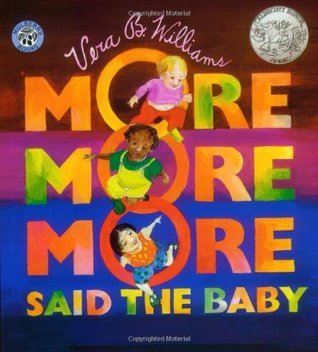
Age 4 – 8: More, More, More! Said the Baby written and illustrated by Vera B. Williams. A Caldecott Honor Book. Publisher: Greenwillow Books. New York, NY. 1990. 29 Pages. Cost: $9.66 Hardcover (Amazon). ISBN: 0-688-09174-1
On the back cover of this Caldecott Honor Book jacket, Vera B. Williams (1990) says she was inspired to write this book because she “attained grandmother status” (More, Jacket Cover). When I purchased this children’s book for my son almost 30 years ago, I didn’t see it as a multicultural book. It was the sweetest declaration of love written by a grandma who saw her grandbabies as the best parts of her life. In fact, when I read this to my young son, his response was that beautiful monosyllabic word, “more.”
Young readers will enjoy listening to the simplicity of the language and storyline coupled with the colorful choices in the illustrations. The relationships we encounter in this book are clearly multicultural. As Williams introduces readers to “Little Guy, Little Pumpkin, and Little Bird,” parents will see how Williams has managed to include a variety of babies, their family members, and their delights in things other than food or toys. The movement in Williams’ illustrations are subtle but priceless. The sheer joy in the babies’ faces elicits nothing buy joy from the readers/listeners. In the end, Williams has created a book that leaves readers wanting more.
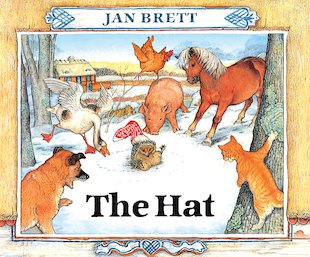
Age 9-11: The Hat written and illustrated by Jan Brett. Publisher: G.P. Putnam’s Sons. New York, NY. 1997. 28 Pages. Cost: $16.95 (USA) $22.95 (CAN). ISBN: 0-399-23101-3
If you’ve ever lost a sock in the dryer, then The Hat (1997) is the book for you! The Hat follows Hedgie, the Hedgehog, who was lucky enough to “find” a sock that fell off the clothesline. Hedgie struggles to get rid of the sock on his head but not before the other animals on the farm see him. He first encounters the mother hen who laughs at him before asking what is on his head. To hide his embarrassment, Hedgie boldly announces, “Why it’s my new hat” …” Isn’t it beautiful?” (p. 7). The mother hen doesn’t respond; she just cocks her head and runs off with an idea. Hedgie continues to struggle to get this sock off his head, meeting a new animal with each struggle and each animal laughing at him. Will Hedgie ever get the sock off his head? The Hat speaks to being the first brave person to try something new that may look silly but is actually a good idea. The ending has a fun surprise that reveals the message of acceptance and inclusion. If you have a hedgehog, maybe you didn’t lose your sock to the dryer. Maybe your hedgehog is just a fashion trendsetter!
Brett’s book will delight children in early elementary grades who may have a hedgehog as a class pet who will immediately understand the antics of such a small animal. Those who don’t have a hedgehog may clamor for a class or home pet since Hedgie is depicted as cute beyond cuteness. Hedgie’s has some great qualities which could spark great discussions with elementary students. He is first embarrassed by his situation, but then determined and tenacious to solve the problem. The illustrations are also beautiful and demure. Brett has created a continuum in the animal Hedgie will encounter next as each watch Hedgie’s tribulation. These animals show the same curiosity a librarian might see on students’ faces in a read aloud – what is happening and what will happen next?
I was lucky enough to meet Jan Brett, author and illustrator of The Hat, when she visited a local bookstore. I brought my eight-year-old son to meet her, and she graciously signed and illustrated his copy of The Hat, which he still treasures today. Having read The Hat again after so many years, it makes sense to put this book in a multicultural category according to the definition provided by the NationalAssociation of Independent Schools (NAIS). NAIS “defines diversity with the term “otherness” and states that diversity “is determined by race, gender, and culture. On a more subtle level, it includes class, sexual orientation, religion, ability, and appearance.” (https://www.nais.org/articles/pages/diversity-and-multiculturalism-147595.aspx (Links to an external site.) Hedgie’s inadvertent choice of headgear gives him an appearance of otherness, and while the animals laugh and jeer at him at first, their acceptance of him with his headwear shows the animals “breaking down the … barriers of equality and justice” (NAIS Website). It’s a beautiful book with a wonderful message.
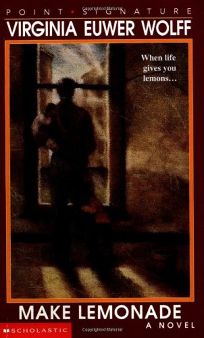
Age 12 – 14: make lemonade by Virginia Euwer Wolff. Publisher: Point Signature a division of Scholastic, Inc. New York, NY. 1993. 200 Pages. $17.07 Paperback (Amazon). ISBN: 0-590-48141-X
“When life gives you lemons…make lemonade.” This novel is a story about two young girls, LaVaughn and Jolly, who need each other and the lessons each learns in the process of getting that help. LaVaughn is fourteen and wants to go to college. (Her mother will see to it that she does.) LaVaughn wants to earn some money to help get herself there, so she answers an ad for a babysitter. Jolly has two babies; Jeremy is two and Jilly is a “gooey baby” (p. 6). At seventeen, Jolly is struggling, “I can’t do it alone no longer, see, I’ll get fired, it’s a good job…” (p. 7). Virginian Euwer Wolff (1993) writes this book that sounds like the prose one might lift from a diary. The voice, like the setting and characters, is authentic, honest, and brutal. Readers can hear LaVaughn’s fourteen-year-old self telling us this story. It is hers, after all. The simplicity of this stream-of-consciousness voice is powerful because we get to hear the honesty of LaVaughn’s situation – she isn’t sure about what she’s doing, but she knows she has to help. As LaVaughn says, “Other people would maybe tell it different but I was there” (p.3). This novel may require a permission slip – not for inappropriate language but for the realistic portrayal of the details. Seeing poverty set in this way will be an eye-opener for unprepared readers. The reality of a seventeen-year-old with two babies is timely and disturbing. The theme of helping someone rise out of their lot in life is expertly written.
This novel provides readers with a view of how poverty and lack of education combine to create some dire economic struggles that come with making choices. The idea that a seventeen-year-old girl with two babies will not seek assistance from government programs because she doesn’t want to lose her children is both honorable and foolish. The struggles Jolly endures because of her choices is heartbreaking, but admirable. The fact that LaVaughn sees her education as her ticket out of a potentially similar situation is huge. Most children who live in poverty have heard that education is their ticket out – can LaVaughn make it? Will she help Jolly get her education AND keep her babies?
make lemonade is Wolff’s first novel in a trilogy. The other two novels, True Believer and This Full House follow LaVaughn in her quest to go to college and the obstacles she faces just being a teenager from a disadvantaged area. The challenges she has grown up around rear their ugly heads again in these two novels, but their message is clear. Education is the ticket out.
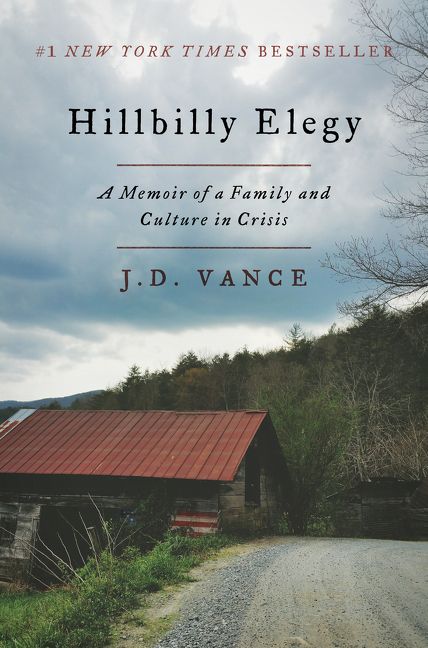
Age 15+ Hillbilly Elegy: A Memoir of a Family and Culture in Crisis by J.D. Vance. Publisher: Harper Collins. New York, NY. 2016. Digital Edition Published May 2018. 273 Pages. $10.74 (Amazon Prime) $11.99 Kindle Edition). Digital ISBN: 978-0-06-287225. Print ISBN: 978-0-06-230055-3
In his introduction, J.D. Vance (2016), author of Hillbilly Elegy, writes “… I didn’t write this book because I’ve accomplished something extraordinary. I wrote this book because I achieved something quite ordinary, which doesn’t happen to most kids who grew up like me” (p. 1). Vance continues to tell us his statistics: he was poor from the Rust Belt in Ohio, had a “complex relationship” with his parents, and grandparents who never finished school (p. 2). He mentions the “grim future” he faced but then reveals his accomplishments – a lawyer who graduated from an Ivy League School: Yale. As his memoir unfolds, Vance takes readers on a journey with the same twists and turns one might find in the back woods of rural Kentucky. Jackson, Kentucky that is. Readers will laugh and cry with the voices Vance introduces us to: Mamaw with her harsh, no nonsense, salty language; Papaw who is the only ‘stable’ father figure Vance will ever know; Bev, his addicted mother, and the string of male ‘fathers’ she provided for her children; we meet Lindsay, his sister, who took on the role of the responsible adult when it was necessary; and we’ll meet the village of people who helped Vance reach his goal of rising up and out of his “grim future.”
This memoir falls into the multicultural literature genre because Vance allows readers into the world of the Scots-Irish from the Appalachia area (p.3). He introduces readers to the diverse culture he emerged from in Middletown, Ohio which included race and religion and the social culture he had to learn to adapt to in New Haven as a Yale law student. Vance crafts a personal narrative embedded with data and statistics on poverty and the working white class – so the memoir reads as non-fiction in places. He says, “my primary aim is to tell a true story about what that problem feels like when you are born with it hanging around your neck” (p.8). The power in this memoir comes from the stark reality painted in the painful, personal recollections Vance shares with readers. White working-class poverty is an ugly truth few have seen poised so vividly. Readers will understand Vance’s message early and thoroughly – no one gets along in this world without a little help from others. He is profoundly grateful for the people in his life who guided his journey, even, and perhaps, especially, those people who taught him what not to do and how not to behave in life.
Mature high school readers of this memoir may require a permission slip for the salty language and certain sexual situations described. Adult readers will have to suspend what they think they know about hillbilly culture. Not all hillbillies are created equal, and Vance does a good job explaining why this is so with personal examples and hard data to back him up. The politics in this memoir may also upset some readers, but Vance shows how politics and culture don’t always go hand in hand. Hillbilly Elegy is a must read for students and educators alike who want to expand their definition of how multiculturalism does not depend on color alone.
References
Brett, J. (1997). The hat. New York, NY: G.P. Putnam’s Sons.
National association of independent schools (n.d). Diversity and multiculturalism. Retrieved from https://www.nais.org/articles/pages/diversity-and-multiculturalism-147595.aspx
Williams, V.B. (1990). More, more, more! Said the baby. New York, NY: Greenville Press.
Wolff, V.E. (1993). make lemonade. New York, NY: Point Signature, a Division of Scholastic, Inc.
Vance, J.D. (2016). Hillbilly elegy. New York, NY: Harper Collins.
 Educating Edis